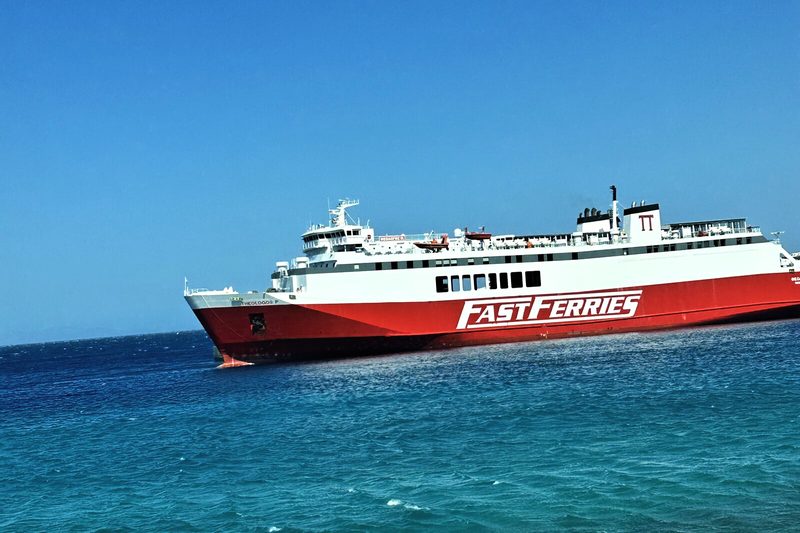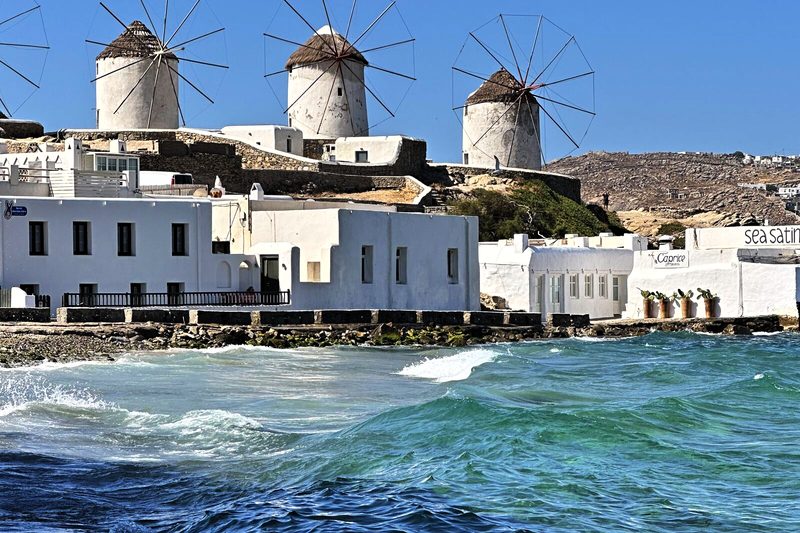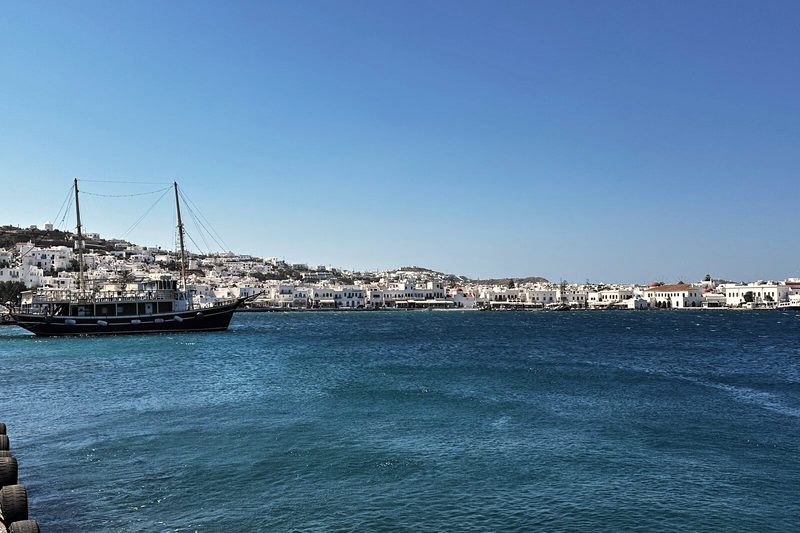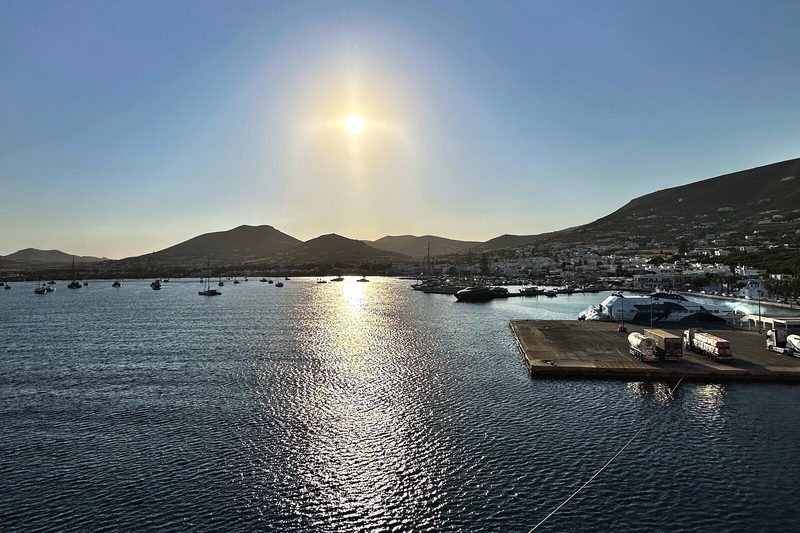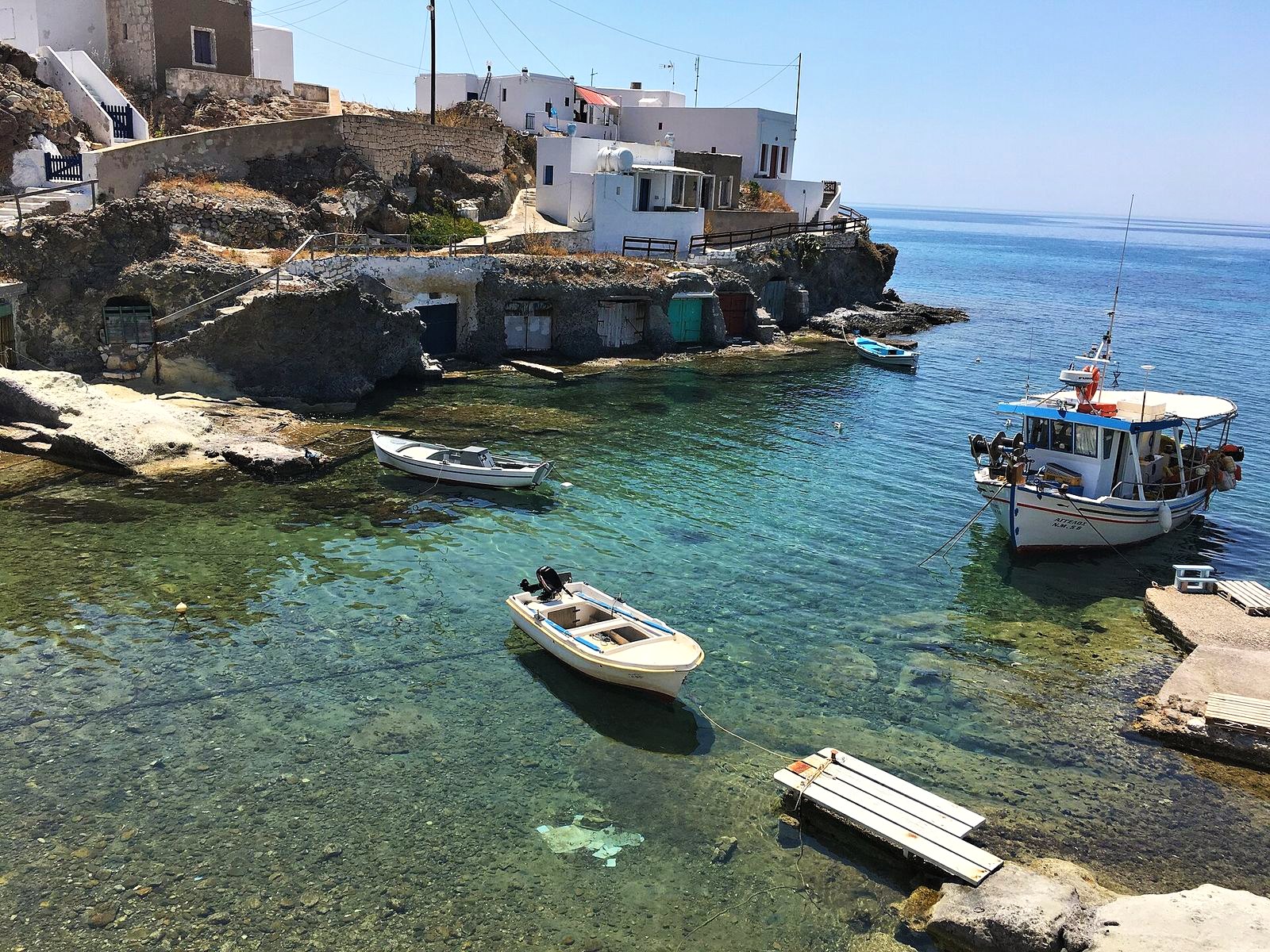
Chalk dust. Cedar shade. A single village on a hill. Kimolos sits so close to Milos that you can read the colours of the boat-house doors across the water, yet it belongs to a different decade. The island is made of kimolia, the white chalk that takes its name from the island, and the light bounces off it until the sea looks lit from below. One small ferry shuttles across from Pollonia in about twenty minutes. Step off at Psathi, walk the fifteen minutes uphill to Chorio, and the day-trippers thin out behind you until you have the lanes, and most of the beaches, to yourself.
Why go
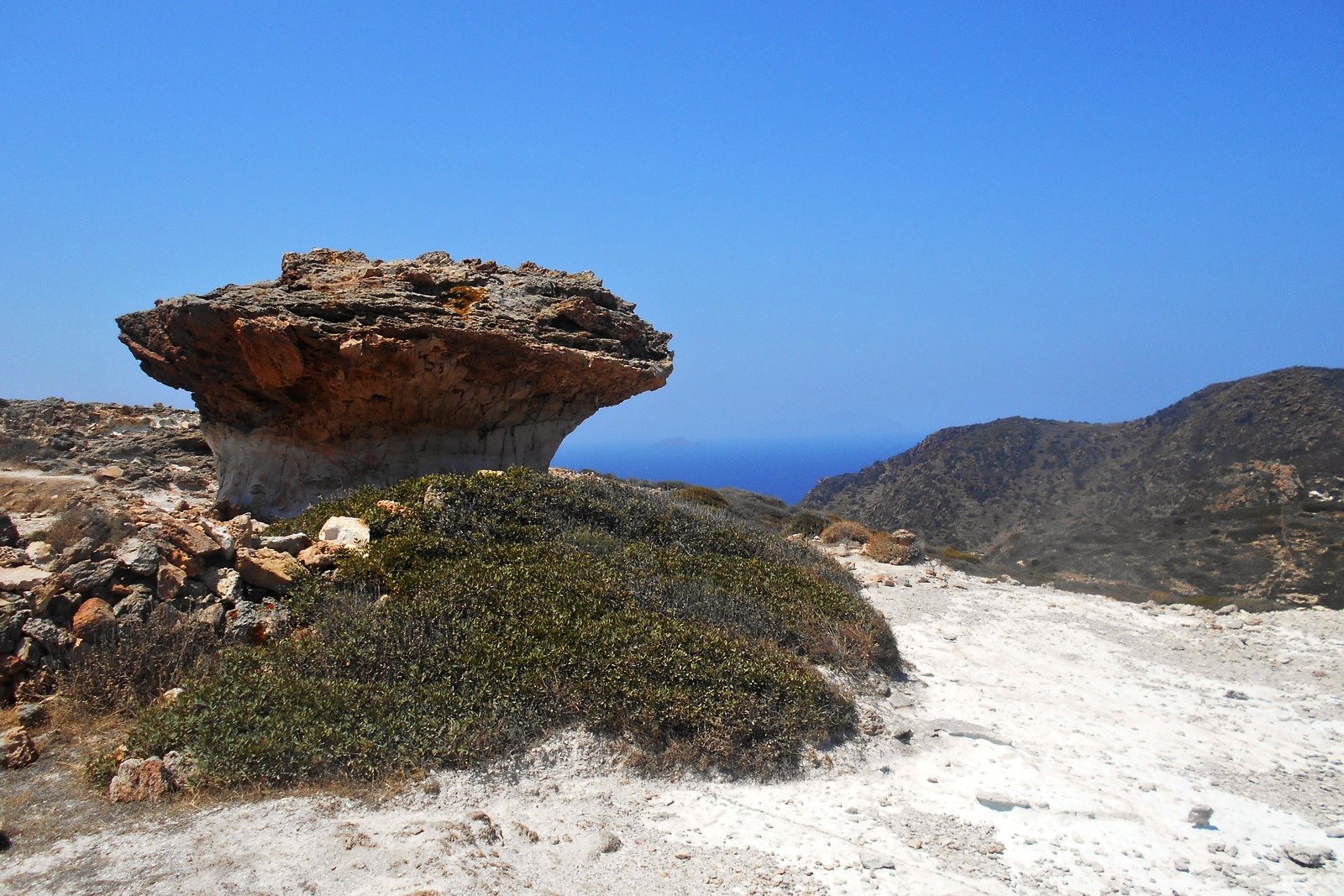
Because it is what Milos was before the coaches came. Kimolos has no Chora in the usual sense, just Chorio, a village built as its own fortress, where the outer ring of houses was the wall. Inside, a medieval kastro of broken lanes, lit at night, is the best thing on the island. Beyond are south-facing sandy bays that stay calm when the meltemi is tearing up Milos, a mushroom of eroded rock called Skiadi alone on a ridge, and the uninhabited island of Polyaigos, with sea caves and monk seals, a short boat ride away. It is a day trip most people wish they had made an overnight.
The lie of the land
Kimolos is small, about 36 square kilometres, and nearly round; everything you need is on the south-east corner. Psathi is the port: a working harbour with a sandy beach, a couple of tavernas, the ferry quay and, in summer, scooter hire on the road up. Chorio is a kilometre and a half uphill, the only real settlement, with the shops, bakeries, museums and most of the rooms. Walk its outer ring and you are walking the medieval wall; dive into the Kastro at the centre and the lanes narrow to the width of a donkey.
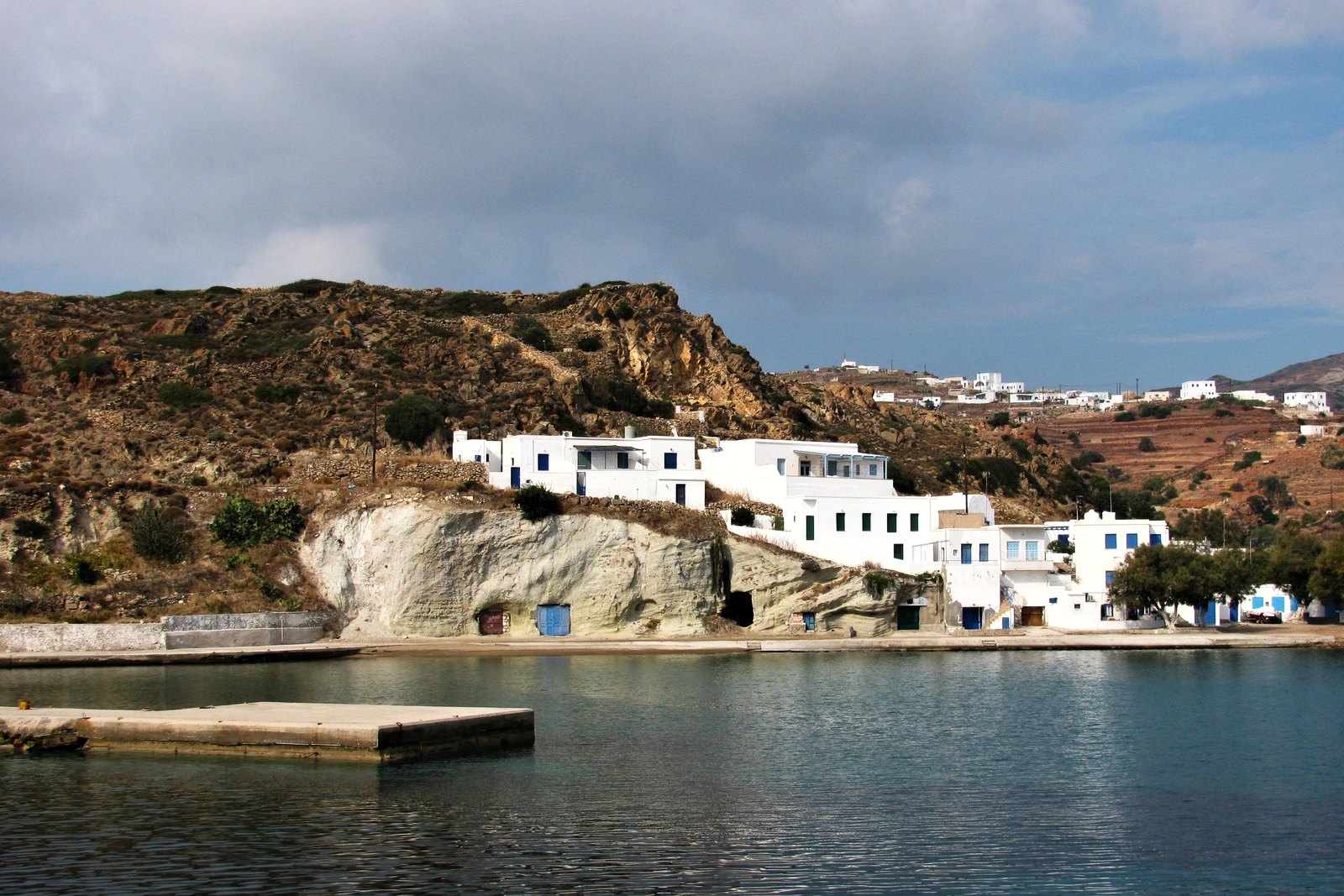
South of Chorio, within a half-hour walk, is a string of sheltered beaches: Aliki, Bonatsa and Kalamitsi, all sandy, shallow and shaded by the odd cedar. North-east, past the fishing hamlet of Goupa-Karra with its syrmata boat-houses cut into the rock and the sandy bay of Klima, is Prassa, the showpiece: coarse white sand, water the blue of a swimming pool, and a pier where hot springs seep into the sea. The west is empty, with rough tracks to Dekas, Ellinika, where you snorkel over the walls of a submerged ancient town, and Mavrospilia, the sunset beach. Skiadi sits on the ridge above.
Eat & drink
- Meltemi, Chorio – creative Kimolian cooking from chef August Galanos; views to Polyaigos and Milos.
- Sardis, Aliki – family fish taverna thirty metres from the sand; shrimp saganaki, lobster pasta.
- To Raventi, Psathi – port café for breakfast, handmade sweets, ice cream and an evening cocktail.
- Taverna Kalamitsi, Kalamitsi beach – family-run since 1991, chairs on the sand, vegetables from the garden.
- Paradosiakos, Chorio – one of the village’s two bakeries, for ladenia, the island’s tomato-and-onion flatbread, baked every morning.
Stay
- The Windmill Kimolos, between Psathi and Chorio – five small, simple rooms in a windmill of 1852; you come for the terrace, the breakfast and the view; mid-range.
- Bonatsa Beach House, Bonatsa – simple renovated rooms a few steps from the sand; you pay for the position, not the fittings.
- Thalassa Beach House, Zacharias – a single beachfront studio for two on a quiet south-coast bay; mid-range.
- Kimolia Gi, Agios Georgios, near Prassa – stone studios with sea views at the wild north-east tip; mid-range, car needed.
Things to do
- Walk the outer ring of Chorio, then lose yourself in the Kastro lanes after dark.
- Visit the Folk and Maritime Museum inside the Kastro and the Archaeological Museum opposite the church of Panagia Odigitria.
- Swim at Prassa and find the warm spring at the pier.
- Photograph the painted syrmata at Goupa-Karra and snorkel the ledges beyond them.
- Hike the marked trail to Skiadi, about an hour from Chorio, or 20 – 30 minutes from the end of the dirt road.
- Snorkel the submerged ancient town at Ellinika.
- Take a boat to Polyaigos, the largest uninhabited island in the Aegean, for the sea caves.
- Eat ladenia warm from the bakery, standing up.
- Watch the sun go down at Mavrospilia.
Getting there & around
From Milos. The little ferry Osia Methodia sails from Pollonia to Psathi in about 25 minutes, several times a day in summer and less often in spring and autumn. Tickets, about €2.30 each way (€4.50 on some weekend sailings), are bought at the ticket offices on the quay in Pollonia or Psathi, not online. Check the last return sailing when you buy; if a strong meltemi is forecast, you may be stranded for a night.
From Piraeus. A few of the slower conventional ferries on the western Cyclades line call at Kimolos in summer, taking roughly six to seven hours. Most visitors come through Milos.
Getting around. Walking covers Chorio and the near beaches. A single seasonal bus links Psathi, Chorio and the main beaches in high summer. Scooters and ATVs are hired at the port for roughly €15 – €50 a day. Cars are kept out of Chorio’s lanes on summer evenings, so park at the edge.
When to go
June and September, when the island is quiet and the walking is comfortable. In July and August the midday heat makes Skiadi an early-morning job and the day boats bring a small afternoon rush. Late April and May are green and flowering.
Good to know
- Water. Carry it. The beaches have no taps and little shade.
- ATMs. In Chorio and at the port in Psathi, not always stocked. Bring cash from Milos.
- Meltemi. Prassa and the north coast take the full force; Aliki, Bonatsa and Kalamitsi face south and stay calm. The channel crossing is the thing most likely to be cancelled.
- Crowds. None to speak of. Day-trippers arrive early afternoon and leave before sunset.
- Prices on Delian are approximate and seasonal.
Twenty minutes across the water and fifty years back in time.