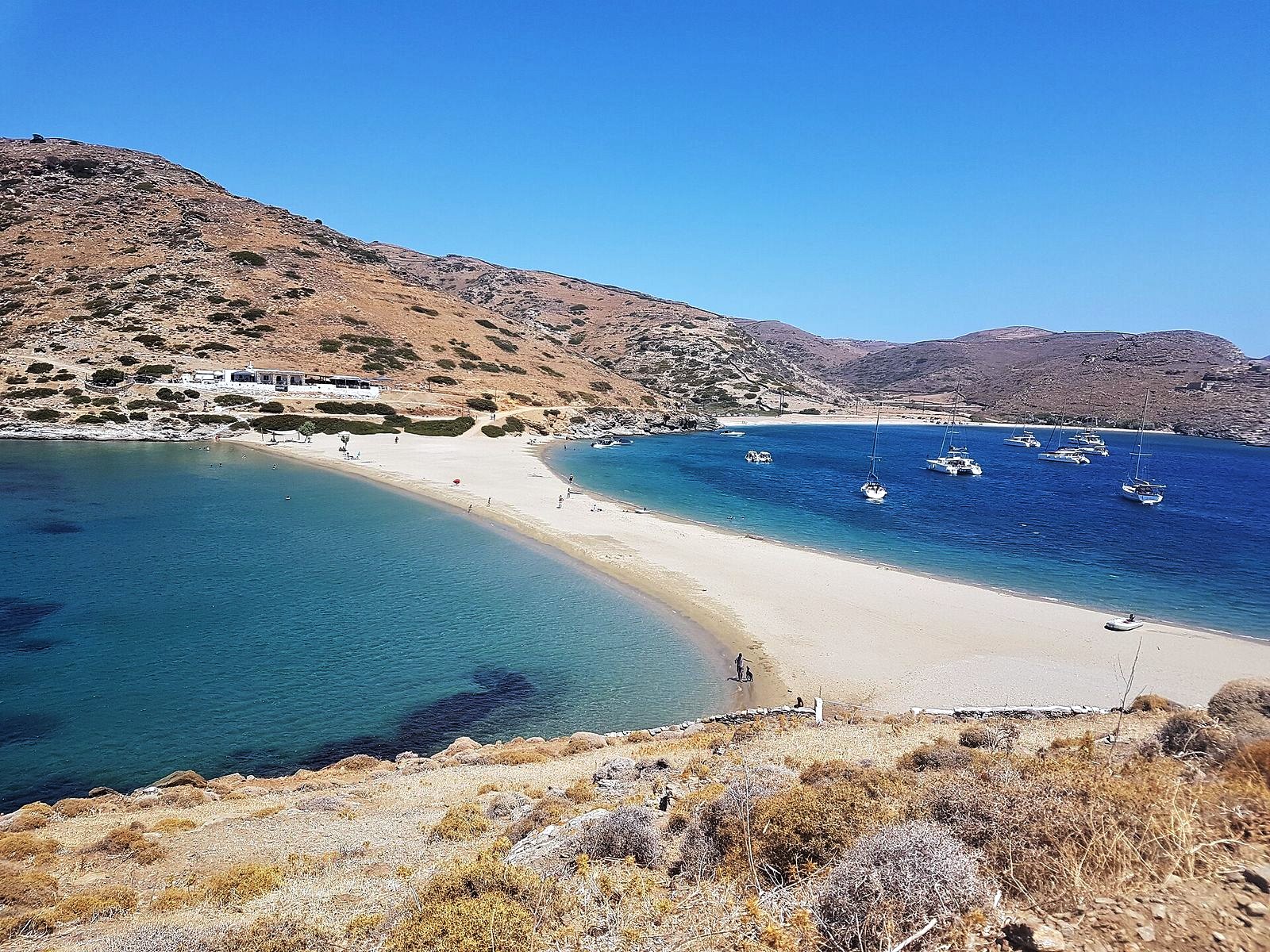
Warm water between your toes. Not the sea, which is cool here in June, but the spring at Loutra that runs down a stone channel across the beach and into it. Kythnos has been known as Thermia, the hot island, since antiquity, and a spa built in King Otto’s reign still stands by the harbour. But the thing that makes people stop the car and stare is Kolona: a tongue of pale sand joining the island to a rocky islet, with sea on both sides, so you can swim out of the wind whichever way it blows. The rest is rolling, dry and almost empty: two inland villages, a cave and a dozen coves on the first island of the western ferry line, the one most people sail past.
Why go
For Kolona, a double-sided beach that works in any wind and looks, from the ridge above, like something drawn by a child. For Loutra, where you lie in a hot stream on the beach for nothing, below the old royal spa, which is closed for a long restoration. For Chora, whose lanes are painted with white flowers and fish, and Driopida, a tile-roofed village with one of the largest caves in Greece beneath it. And for the price: Kythnos is among the least expensive and least visited islands in the Cyclades.
The lie of the land
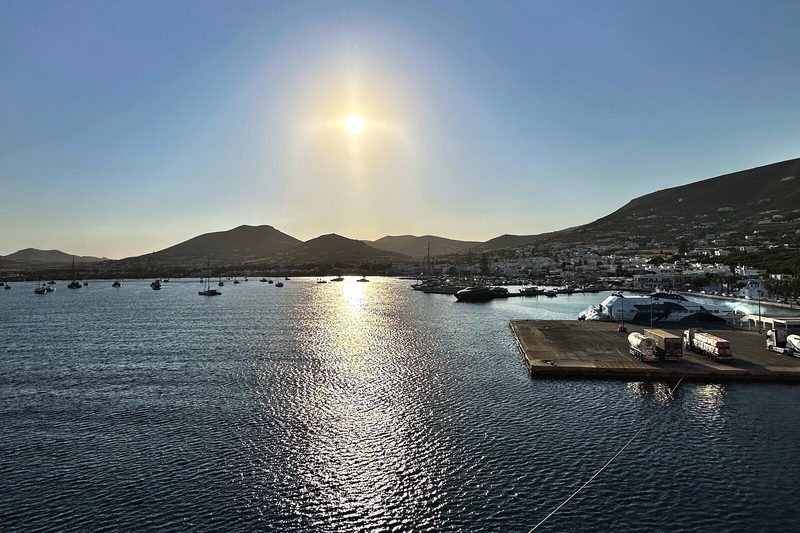
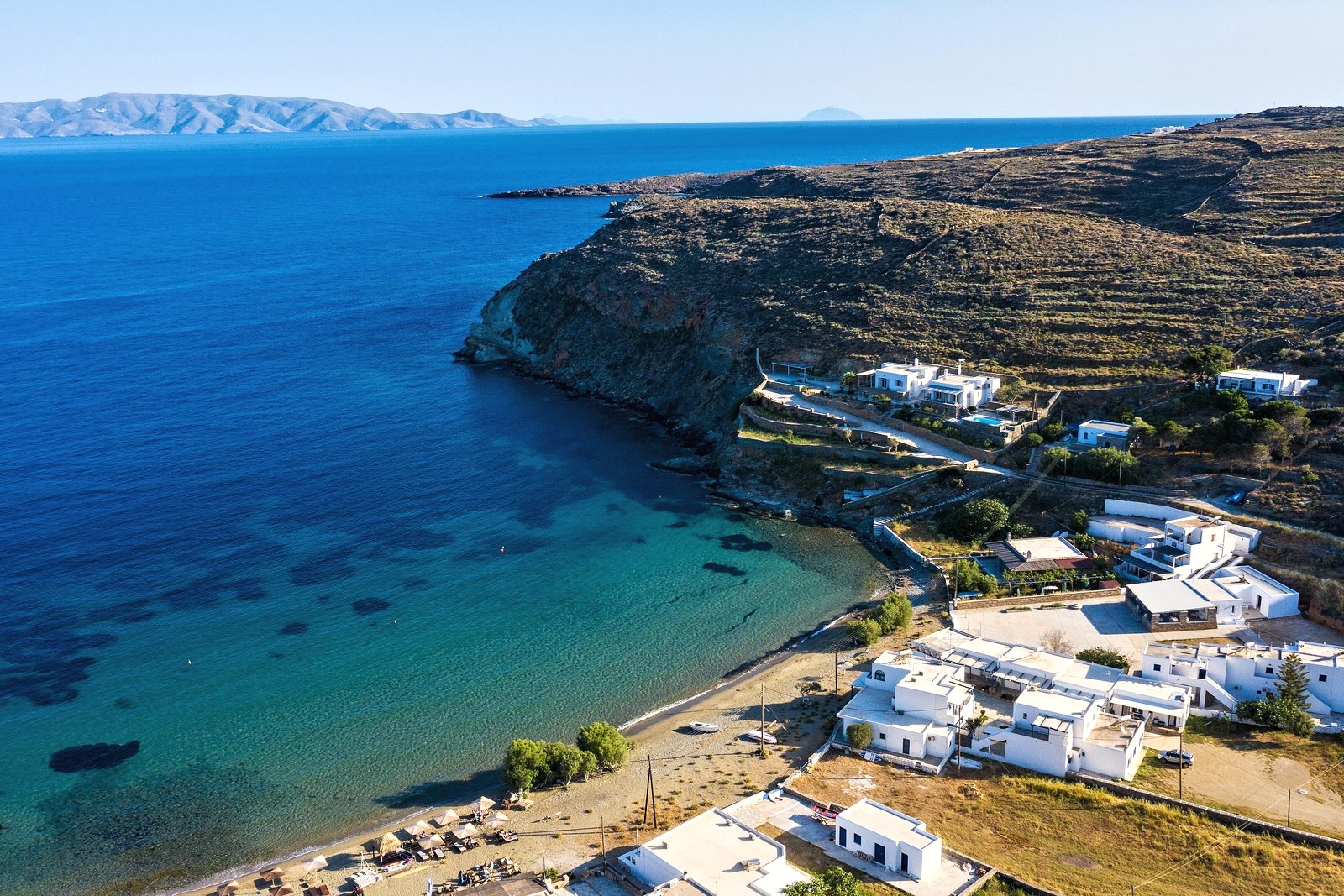
Kythnos is about 20 kilometres long, with the port of Merichas in the middle of the west coast. Chora, properly Messaria, sits inland on the ridge above, a village of white lanes, painted pavements and windmills. South of it, down in a valley, Driopida has red roofs and the Katafyki cave; north of it, the road drops to Loutra, the spa village, with its 19th-century hydrotherapy building, fishing harbour and a beach where the thermal stream meets the sea.
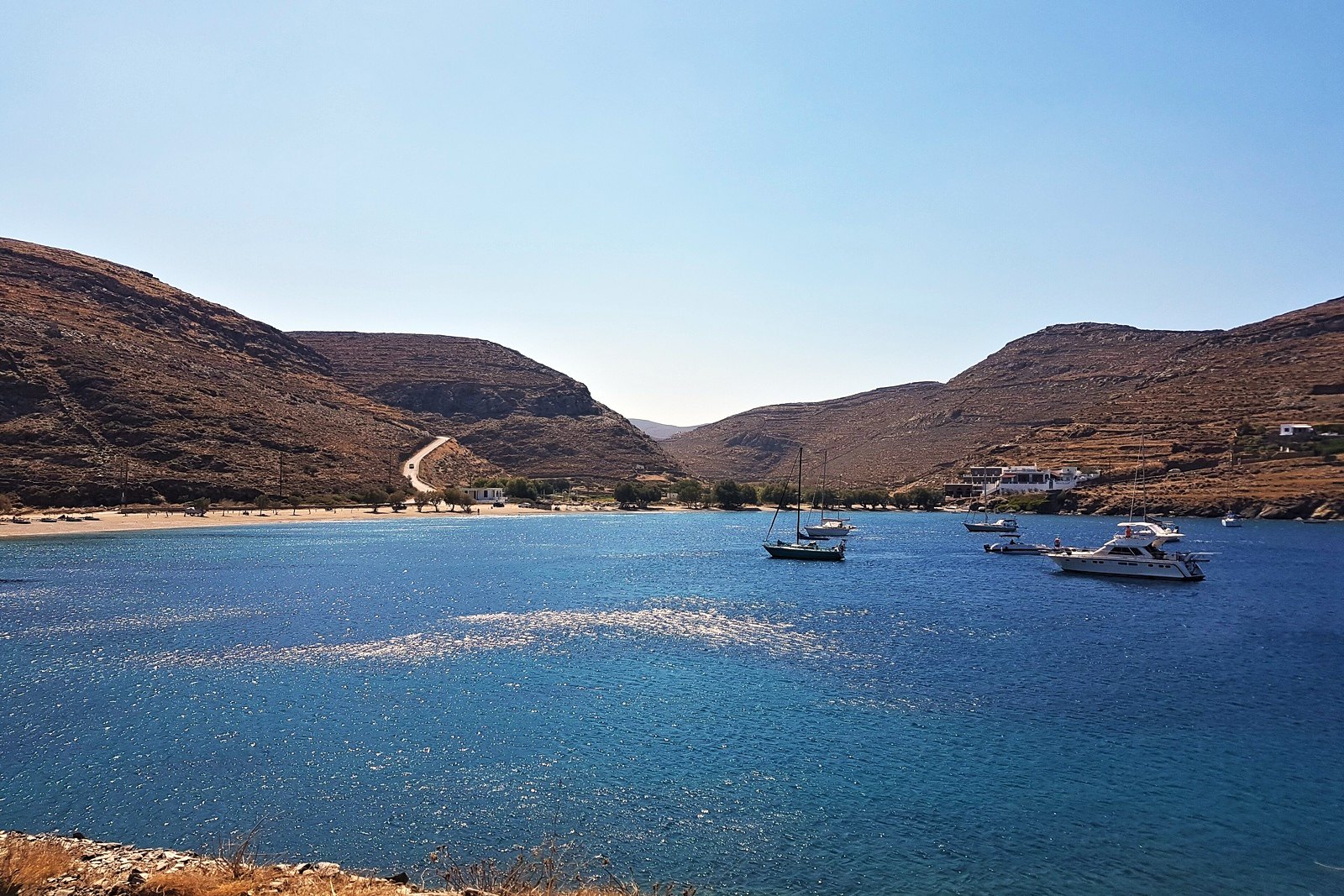
North-west of Merichas, over a rough road or by water-taxi, are the island’s best-known beaches: Apokrousi, a long bay of coarse sand, and beyond it Kolona, the sandbar to the islet of Agios Loukas; the headland of Vryokastro, the ancient capital, lies just south of Apokrousi, above Episkopi bay. The east coast has Kanala, a pine-shaded village around the church of Panagia Kanala, the island’s patron saint, with beaches either side. The south is quieter still: Agios Dimitrios, Flambouria and Gaidouromantra are coves with a taverna or none at all. At the northern tip, reached only on foot, stand the ruins of Kastro tis Orias.
Eat & drink
- Arodou, Agios Stefanos: a fish and seafood taverna a few steps from a quiet east-coast beach, for fried calamari, the day’s catch from the grill and stuffed courgette flowers; seating is limited, so book ahead.
- Margiora, Chora: Mediterranean cooking and good puddings in the capital’s lanes.
- Giagia Koukou, Chora: Greek cooking with a lighter, modern hand on Anemomylos Square, from handmade pies to prawn pasta with courgette, ginger and lime; book for a late table.
- Sofrano, Loutra: the Yachting Club restaurant in the village, a short walk from the harbour, serving seafood since 1994.
Stay
Price bands are approximate high-season rates per night: € under €100, €€ €100 – €200, €€€ €200 – €400, €€€€ above €400.
- Amal, Episkopi (€€€): 13 suites and two-bedroom villas, many with private pools, above the west-coast beaches.
- Chora Kythnos Suites, Chora (€€ – €€€): a small, warmly run adults-only hotel with a pool on the road into Chora, a few minutes’ walk from the lanes; rooms are compact.
- Porto Klaras, Loutra (€€): a family-run complex of studios and family suites, 30 metres from the water, with warm welcomes.
Things to do
- Swim both sides of Kolona and walk out to the islet of Agios Loukas.
- Lie in the hot stream on Loutra beach, beside the old spa, which is closed for restoration.
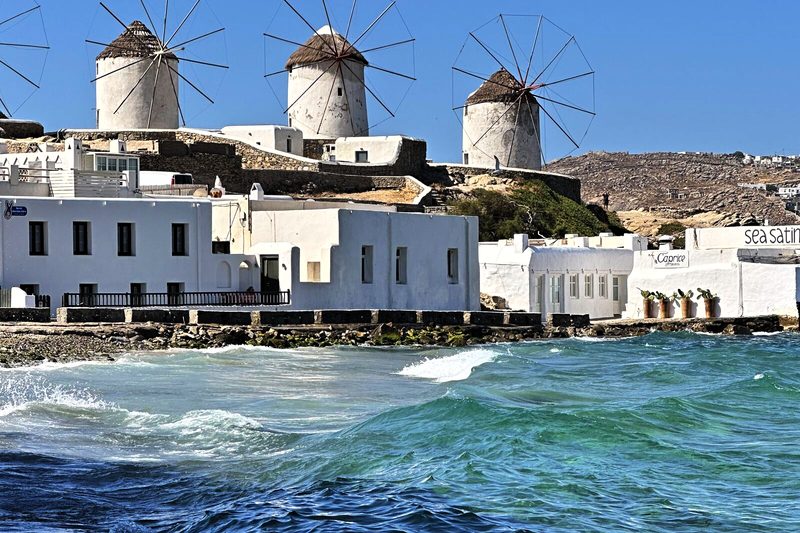
- Wander Chora’s painted lanes in the evening and climb to the windmills.
- Go underground at the Katafyki cave in Driopida, then visit the village’s Byzantine Museum.
- Walk out to the ruins of Kastro tis Orias at the northern tip.
- Spend a day at Apokrousi, with a detour to the ancient site of Vryokastro.
- Visit Panagia Kanala and swim at the beaches below the pines.
- Eat sfougato, the island’s cheese fritter, and buy thyme honey and amygdalota.
Getting there & around
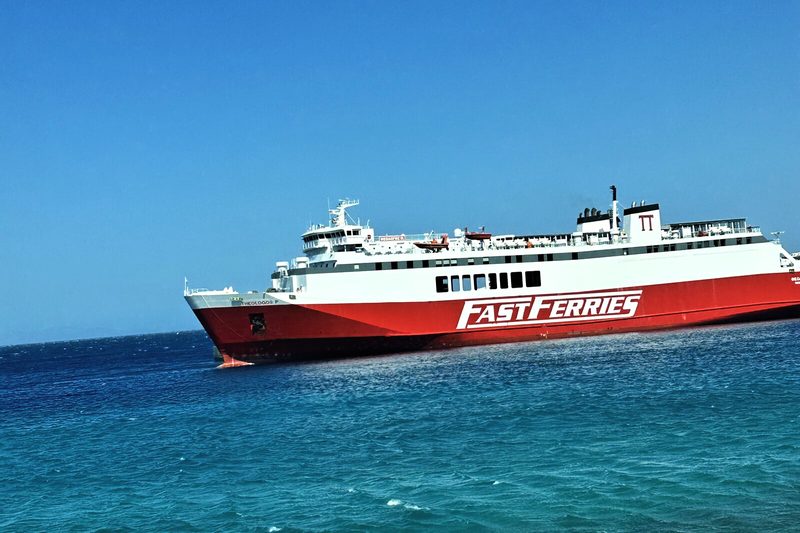
Kythnos has no airport. Ferries from Lavrio take about 2 hours and run daily in summer; from Piraeus there is no longer a regular conventional boat, but from June to September a Seajets high-speed makes the crossing in about an hour and a half. Both arrive at Merichas, with summer boats onward down the western line to Serifos (40 minutes to an hour and a quarter), Sifnos and Milos, and links with Kea two or three times a week. A bus runs from Merichas to Chora, Driopida, Loutra and Kanala in season; taxis are few. Hire a car or scooter, and take a 4x4 or water-taxi for Kolona.
When to go
June and September are ideal: warm sea, quiet beaches, hot springs welcome in the evenings. July and August bring yachts and the meltemi, which Kolona handles better than any beach in the Cyclades. Most tavernas close from November to Easter.
Good to know
Carry cash; ATMs are in Merichas and Chora only. Bottled water is the rule. The meltemi blows across the whole island but Kolona always has a sheltered side and Loutra harbour is protected. Crowds are light except on August weekends. Prices are approximate and seasonal.
Hot water, cool sea and a beach that faces both ways: Kythnos lets you choose.