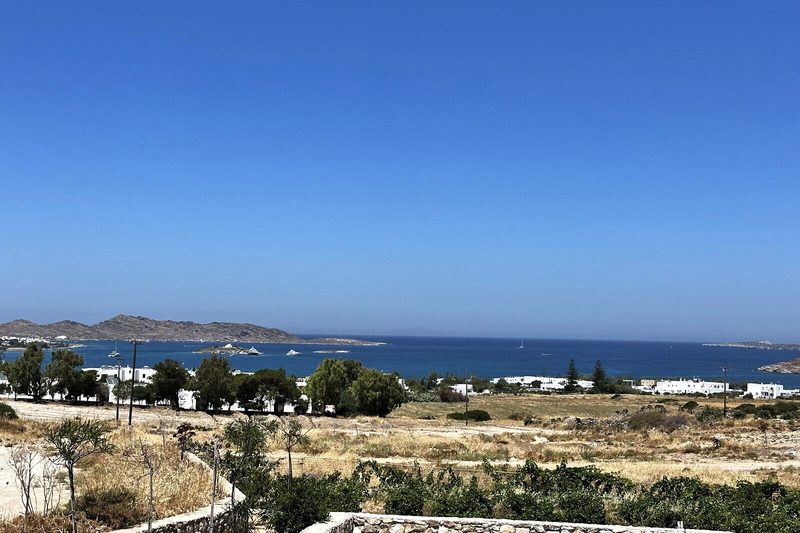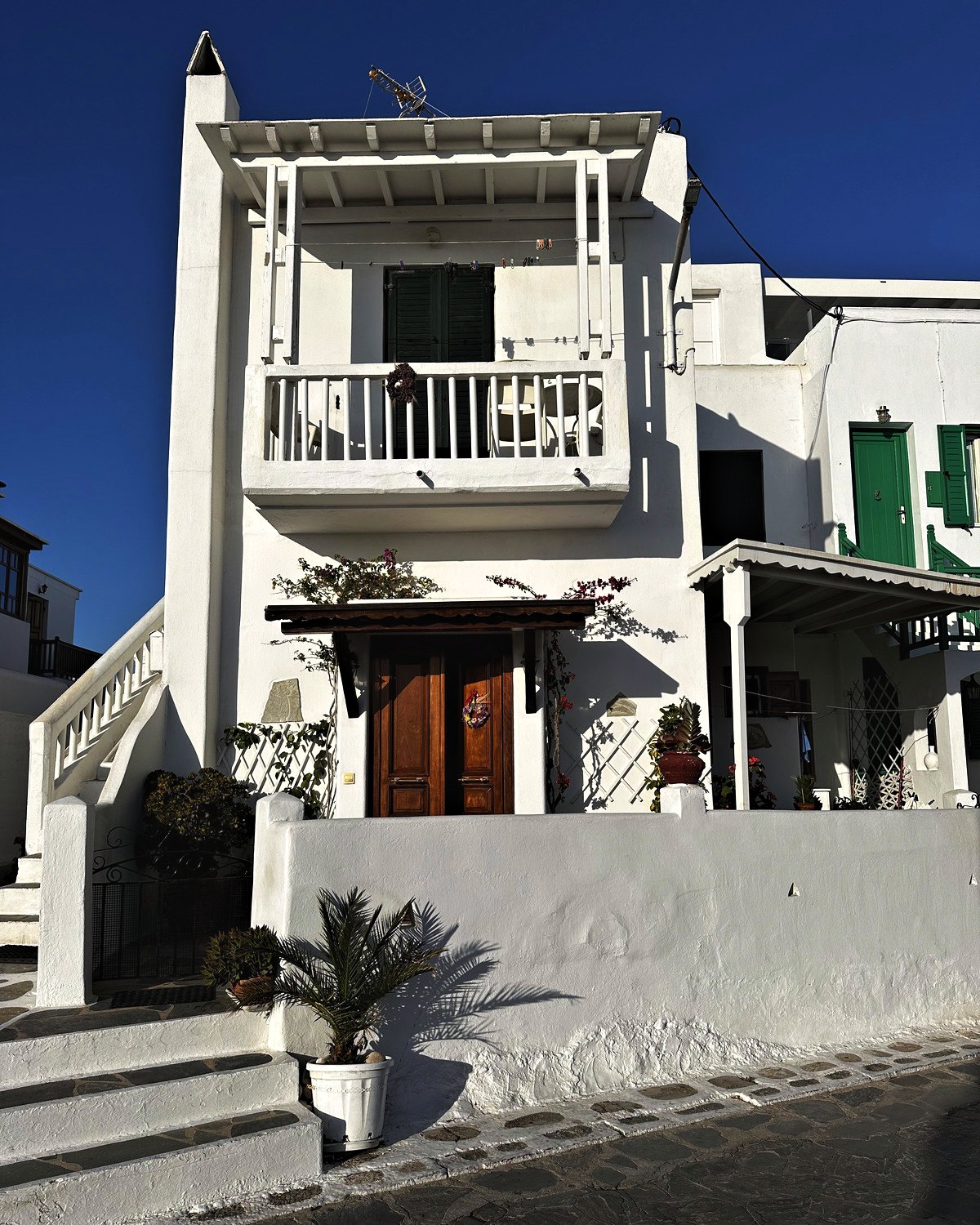
Stone walls, a blue door, the sea at the end of the lane. Almost everyone who spends a fortnight in the Cyclades has the same thought on the last ferry out: what would it cost to own a piece of this? The honest answer is more than the asking price, more time than you expect, and less mystery than you fear. Greece has a clear, notarised process that works well for foreign buyers if you follow it in order and pay the right professionals. Here is how it goes, and where an owner-builder’s instincts help – and where they don’t.
Who can buy
EU citizens can buy anywhere in Greece without restriction. Non-EU buyers (South Africans, Americans, Britons, Australians) can too, with one wrinkle: parts of the country near borders are “border areas” and need a permit for non-EU purchasers. Most of the Cyclades are not among them, but Santorini is: the law names Thira as a border island, so a non-EU buyer there needs the permit before signing. It is routinely granted, though it can add several months. You buy in your own name, through a Greek company or through a foreign one, and the choice has tax consequences your accountant should walk you through before you sign anything.
The paperwork first
Before you can do anything in Greece you need an AFM, the nine-digit tax number issued by the tax authority (AADE). A lawyer with power of attorney can obtain it for you in a day. You will also need a Greek bank account – banks have become slower about opening these for non-residents, so start early and bring proof of address, proof of income and your passport. Money for the purchase must come through the banking system, not in cash, and the notary records the transfers.
Appoint a lawyer independent of the agent and the seller. Their job is the title search at the land registry and the Cadastre (Ktimatologio): mortgages, inheritance claims, unregistered rights of way and, crucially on the islands, whether the building matches its permit. Greece spent a decade regularising unauthorised structures under Law 4495/2017; an undeclared extra room or an unpermitted pool must be settled before sale, and the cost falls into the negotiation. Every transfer also needs an electronic building identity file and an energy performance certificate.
What it costs on top
Budget roughly 8 – 10% over the price, and nearer 20 – 22% if you live outside the EU and sign the final contract on or after 1 July 2027, when the new 15% transfer tax starts. The pieces, according to Engel & Völkers (2026):
- Transfer tax: 3% on the higher of the contract price or the tax-assessed value, plus a 3% municipal surcharge on the tax itself, giving the familiar 3.09%. From 1 July 2027 that changes for buyers who live outside the EU. Law 5355/2026, published on 13 November 2026, raises the rate on homes to 15% (about 15.45% with the surcharge) for buyers who are tax residents outside the EU and EEA, on final contracts signed from that date, according to Get Golden Visa (November 2026). It turns on where you are tax resident, not on your passport, and covers homes only: commercial property and land stay at 3.09%. On a €600,000 house the tax rises from about €18,500 to about €92,700, so if you live outside the EU and can sign before 1 July 2027, it pays to. Ask your lawyer how the law treats deposits already paid, purchases through a company and the exemptions it allows. New builds would attract 24% VAT instead, but that VAT is suspended until the end of 2026 and the government has said it will carry the suspension into 2027, so almost everything is bought under transfer tax; check the extension has been enacted before you budget for a new build.
- Notary: roughly 0.8 – 1% of the value, plus 24% VAT, on a sliding scale that eases for bigger numbers. The notary is a public official who drafts and reads the contract aloud; both parties attend or send a proxy.
- Lawyer: typically 1% plus VAT for a straightforward purchase; expect closer to 1.5 – 2% if there is regularisation or a complicated title.
- Land registry and Cadastre: about 0.5% plus small fixed fees.
- Agent: 2% plus VAT from each side is the norm. Agents must be registered and should give you their licence number.
Annual running costs include ENFIA, the yearly property tax, which depends on zone value, size and age; Grekodom (December 2025) notes a 20% reduction for homes under €500,000 that carry natural-disaster insurance. Add municipal fees collected through your electricity bill.
The Golden Visa
Greece’s residence-by-investment permit changed on 31 August 2024 (Law 5100/2024) and the new tiers remain in force in 2026, according to Global Citizen Solutions (2026). The property route now has three levels:
- €800,000 in Attica, Thessaloniki, the regional units of Mykonos and Santorini (Thira) and any island with a population over 3,100. On the population test, Paros, Naxos, Tinos, Syros, Milos and Andros all fall into this band on the 2021 census.
- €400,000 everywhere else, which in the Cyclades means the smaller islands: Sifnos, Serifos, Kea, Kythnos, Amorgos, Antiparos, Koufonisia and the Small Cyclades. Ios, Folegandros, Sikinos and Anafi sit inside the regional unit of Thira, which the law names alongside Mykonos, so on the letter of the law they fall in the €800,000 band despite their size; have your lawyer confirm before you rely on €400,000.
- €250,000 for two special cases only: converting a commercial building to residential use, or restoring a listed or historic building.
The investment must be a single property of at least 120 m² at the two main tiers, and the permit property cannot go on short-term rental platforms; the fine is €50,000 and the permit is revoked. Long lets are fine. A 2026 amendment starts the five-year validity from the date of issue rather than application. The permit does not require you to live in Greece and gives Schengen travel, but it is not citizenship and does not change your tax residence by itself. Holding or applying for it does not exempt you from the new 15% transfer tax on homes bought from 1 July 2027 (see the costs above).
Indicative prices by island
Asking prices are what the portals show; sale prices are usually a little lower, and ruins, plots and renovation projects sit well below these numbers. Prices per square metre of built house, 2026:
| Island | Indicative asking price, €/m² | Golden Visa tier | Source |
|---|---|---|---|
| Mykonos | 7,000 – 12,000 (prime 16,000+) | €800,000 | Spitogatos Q2 2026; GEOAXIS 2026 |
| Santorini | 5,000 – 7,500 (caldera 13,000+) | €800,000 | Investropa June 2026; GEOAXIS 2026 |
| Antiparos | 6,000 – 9,000 | €400,000 | Spitogatos Q2 2026 |
| Paros | 4,500 – 8,000 (prime 10,000) | €800,000 | Spitogatos Q2 2026; GEOAXIS 2026 |
| Kea | 2,200 – 6,500 | €400,000 | GEOAXIS 2026 |
| Naxos | 2,500 – 4,000 | €800,000 | Investropa June 2026 |
| Syros | 1,600 – 3,000 | €800,000 | Ask Wire Dec 2025; BUY GREECE 2026 |
| Serifos | 1,700 – 4,000 | €400,000 | GEOAXIS 2026 |
| Tinos | 2,000 – 3,500 | €800,000 | Ask Wire Dec 2025; portal asking prices |
| Sifnos, Milos | 2,000 – 4,500 | €400,000 / €800,000 | Portal asking prices, thin data |
Prices across the Aegean islands rose about 5.9% year on year to mid-2026, according to Spitogatos (Q2 2026); luxury homes rose roughly 4 – 5.5% and ordinary houses 3 – 5%, according to GEOAXIS (2026).
Building and renovating
This is where the owner-builder has to recalibrate. In Greece you cannot be your own engineer. Every permit goes through a licensed civil engineer or architect on the e-Adeies platform, and a supervising engineer must sign off the works; their fees are agreed with you in writing, so compare quotes, while the taxes and contributions on the permit are fixed. What you can do is manage the subcontractors, procure materials and hold the programme, which is exactly where money is made or lost on an island.
Four realities to price in. First, plots outside a village’s town-plan line need at least 4,000 m² and a frontage on a recognised road to carry building rights, and some islands ask for more under their own zoning decrees: on Paros the general minimum has been 8,000 m² since 1993. The Council of State has been narrowing the historic exceptions since 2023, and the local urban plans due from 2027 are expected to raise the minimums again – have your engineer confirm buildability in writing before you pay a deposit on land. Second, forestry maps and archaeology: a plot classified as forest cannot be built on, and the Ephorate of Antiquities can halt a dig for months if sherds appear. Third, Cycladic villages are protected traditional settlements with tight rules on height (usually two storeys), colour, roof form and openings. Fourth, logistics: concrete, steel, tiles and labour arrive by ferry, skilled trades are booked a season ahead, and many island municipalities ban noisy works from roughly mid-June to mid-September. Allow 18 – 24 months from permit for a 150 m² new build; a sympathetic renovation of a stone house often costs as much per square metre as new, because of access, hand labour and the surprises inside old walls.
Renting it out
Short lets are legal across the Cyclades and the islands sit outside the central-Athens moratorium, according to BUY GREECE (2026). You register the property with the tax authority and receive an AMA number that must appear on every listing; operating without one draws a €5,000 fine, rising for repeat offences. Since October 2025 (Law 5170/2025) every short-let must carry civil liability insurance, fire extinguishers, smoke detectors, emergency lighting, a bilingual first-aid kit, and electrician’s and pest-control certificates, according to To Vima (September 2025). Guests pay a climate resilience fee per night – €8 in high season for a standard short-let, €2 in winter, higher for large detached houses – which you collect and remit. Rental income for individuals is taxed from 1 January 2026 in bands of 15% to €12,000, 25% to €24,000, 35% to €36,000 and 45% above that, under Law 5246/2025. A villa with staff and services may instead need the older EOT tourist-accommodation licence; your accountant will tell you which regime fits.
One caution for planners: the Special Spatial Framework for Tourism, in force since 7 August 2026, opens the way for the state to restrict or cap short lets in saturated destinations. No island has a cap yet, and the freeze on new registrations still covers only central Athens and central Thessaloniki, but on Mykonos and Santorini it is worth assuming the direction of travel is tighter.
In the right order
Find the house, agree the price subject to due diligence, instruct the lawyer, obtain the AFM and bank account, pay the transfer tax through the myPROPERTY platform, sign at the notary, register at the Cadastre. Then buy the tin of lime wash.
The sea will still be at the end of the lane when the paperwork is done; the trick is to arrive there with the deeds in your name and no surprises in the walls.
Good to knowFigures are indicative for 2026 and change with the law; confirm every number with your lawyer and accountant before you commit.
CostBudget roughly 8 – 10% on top of the purchase price for tax, notary, lawyer, registry and agent; nearer 20 – 22% for buyers living outside the EU who sign from 1 July 2027, when the new 15% transfer tax starts
WhereAll islands, Cyclades
You might also like
- The Cyclades Villa Market: Where the Value Is
- Island Hopping by Ferry in the Cyclades
- Sifnos: The Island That Taught Greece to Cook
Prices and opening times are approximate and change with the season. If something has changed, let us know.