Candle wax on the cobbles. Bells at midnight. Lamb turning over coals from eight in the morning. Greek Easter is the biggest weekend of the year, bigger than Christmas, and the islands do it with a seriousness and a joy that no summer festival matches. In 2027 it comes late, on 2 May, five weeks after the Western date, when the Cyclades are green, the sea is just warm enough and the first hotels have opened their shutters. Here is what happens, day by day, and the islands where it is most worth being.
The dates for 2027
Orthodox Easter Sunday is 2 May 2027. Holy Week runs from Palm Sunday on 25 April; Holy Thursday is 29 April, Good Friday 30 April and Holy Saturday 1 May, with the Resurrection at midnight. Easter Monday, 3 May, is a public holiday. Western Easter falls on 28 March, so if your calendar at home says Easter is over, it has not started here yet.
Holy Week, day by day
Holy Thursday is the day the eggs are dyed red, for the blood of Christ, and the tsoureki, the sweet braided bread scented with mahlepi and mastic, comes out of the bakeries. In the evening the churches read the twelve gospels and the figure of Christ on the cross is brought out; women stay late decorating the Epitaphios, the carved bier, with flowers.
Good Friday is a day of mourning. Bells toll slowly all day, flags fly at half-mast, and nothing with oil, meat or dairy is eaten. Around 9pm the Epitaphios is carried out of each church and through the village by candlelight, with the choir chanting the lament and the whole parish walking behind. On islands with several churches the processions meet.
Holy Saturday builds to midnight. The church fills, the lights go out, and the priest emerges with a single flame, the Holy Light, which passes from candle to candle until the square is lit. At twelve he calls Christos Anesti, Christ is risen, the bells ring, the fireworks go up and everyone answers Alithos Anesti, truly he is risen. Then home for magiritsa, the lamb’s-offal soup that breaks the fast.
Easter Sunday is lamb on the spit from early morning, kokoretsi beside it, red eggs cracked end to end until one unbroken egg wins the year’s luck, and a lunch that lasts into the evening. Easter Monday is for recovering.
Pyrgos, Santorini: a hill of ten thousand flames
The most beautiful Good Friday in Greece, and it is not close.
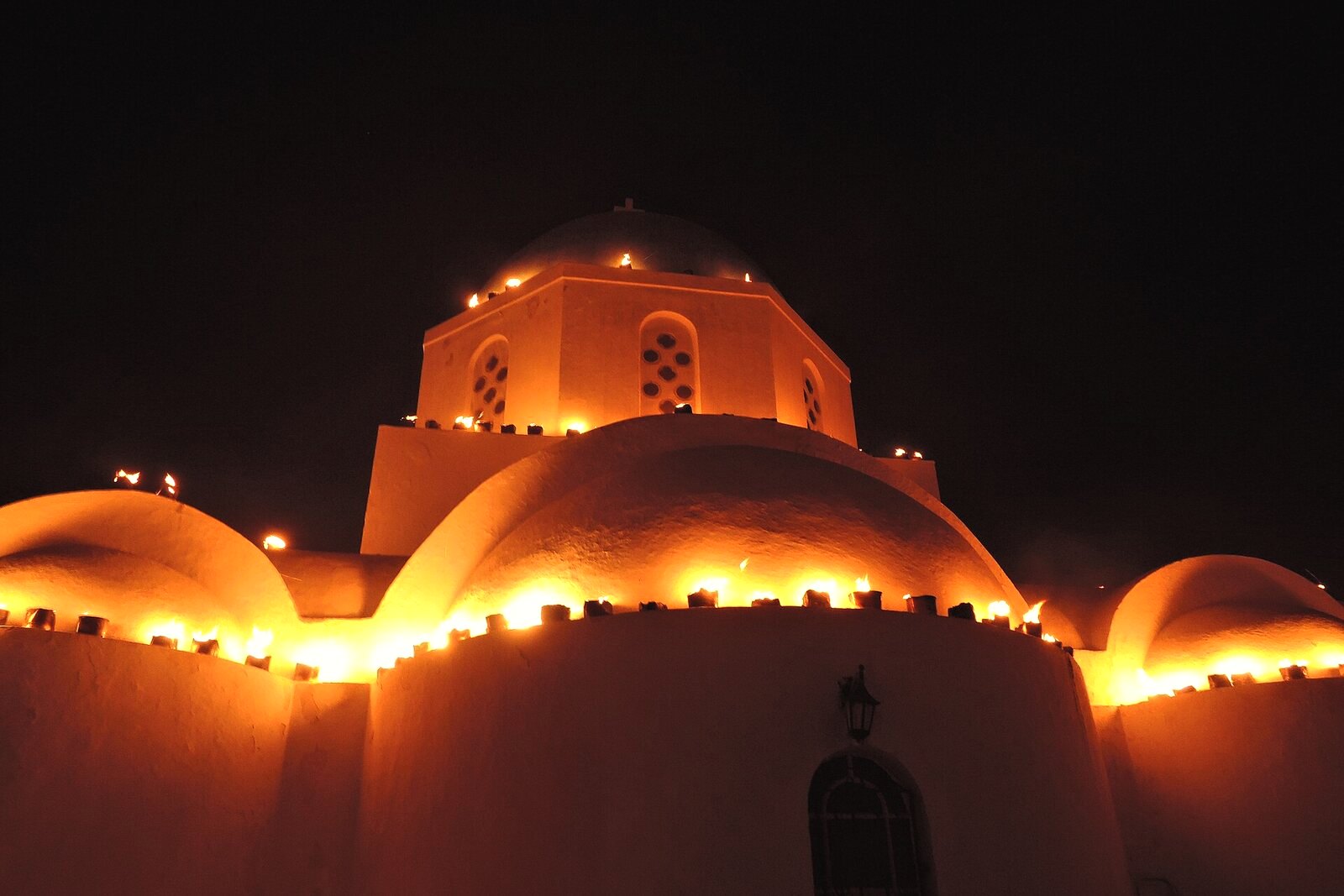
Pyrgos is the old inland capital of Santorini, a cone of white houses wound around a Venetian castle on the island’s highest ridge. On Good Friday evening its people fill thousands of tin cans, the denekedakia, with rags and oil, set them on every wall, rooftop and castle battlement, and light them as the Epitaphios leaves the church. From the road below the whole hill looks like a volcano glowing in the dark; from inside the lanes it is a river of small fires with the procession moving slowly through it. On Saturday night Resurrection fireworks go up from parishes all along the caldera rim. Order melitinia, the island’s Easter pastries of mizithra and mastic, from a Pyrgos bakery on Thursday.
Good to knowPark on the main road and walk up; the village closes to cars for the evening. Go up before 8pm for a spot on the castle.
CostFree
WherePyrgos, Santorini
Folegandros: the icon that visits every house
Three days, one icon, and a glass of something at every door.
On Easter Sunday the icon of the Panagia is carried out of her church on the hill above Chora and begins a journey that takes three days: down to the medieval Kastro, through every lane of Chora, out along the ridge to Ano Meria and down to the port at Karavostasis, stopping at every house on the way for a blessing. At each door the family offers the procession, and anyone walking with it, sweets, a shot of raki or a glass of wine, and traditional dances break out in the squares between stops. It is the island’s great annual act of community, open to anyone who falls into step behind the priest, and it ends with the icon back in her church and the whole island slightly unsteady.
Good to knowThe first ferries of the season reach Folegandros by late April; book a room in Chora early as the island’s few hotels fill for the weekend.
CostFree
WhereChora, Kastro, Ano Meria and Karavostasis, Folegandros
Ermoupoli, Syros: two Easters at once
Catholic and Orthodox, one date, processions that meet on the waterfront.
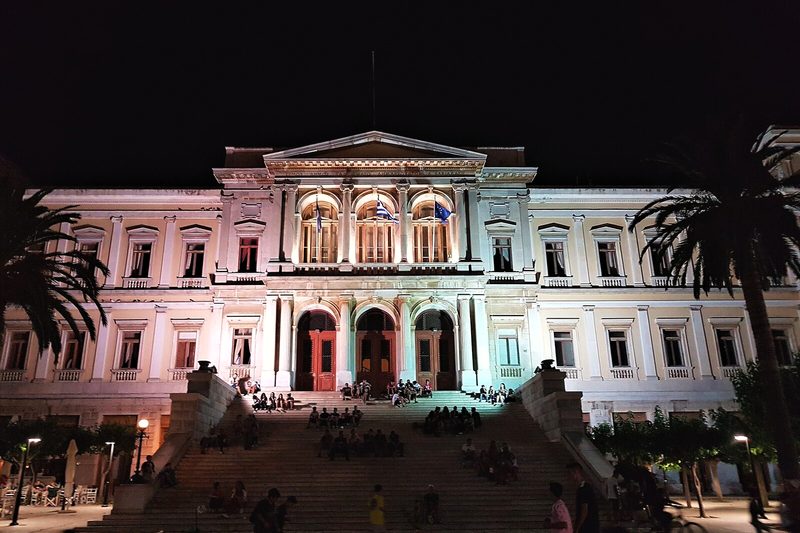
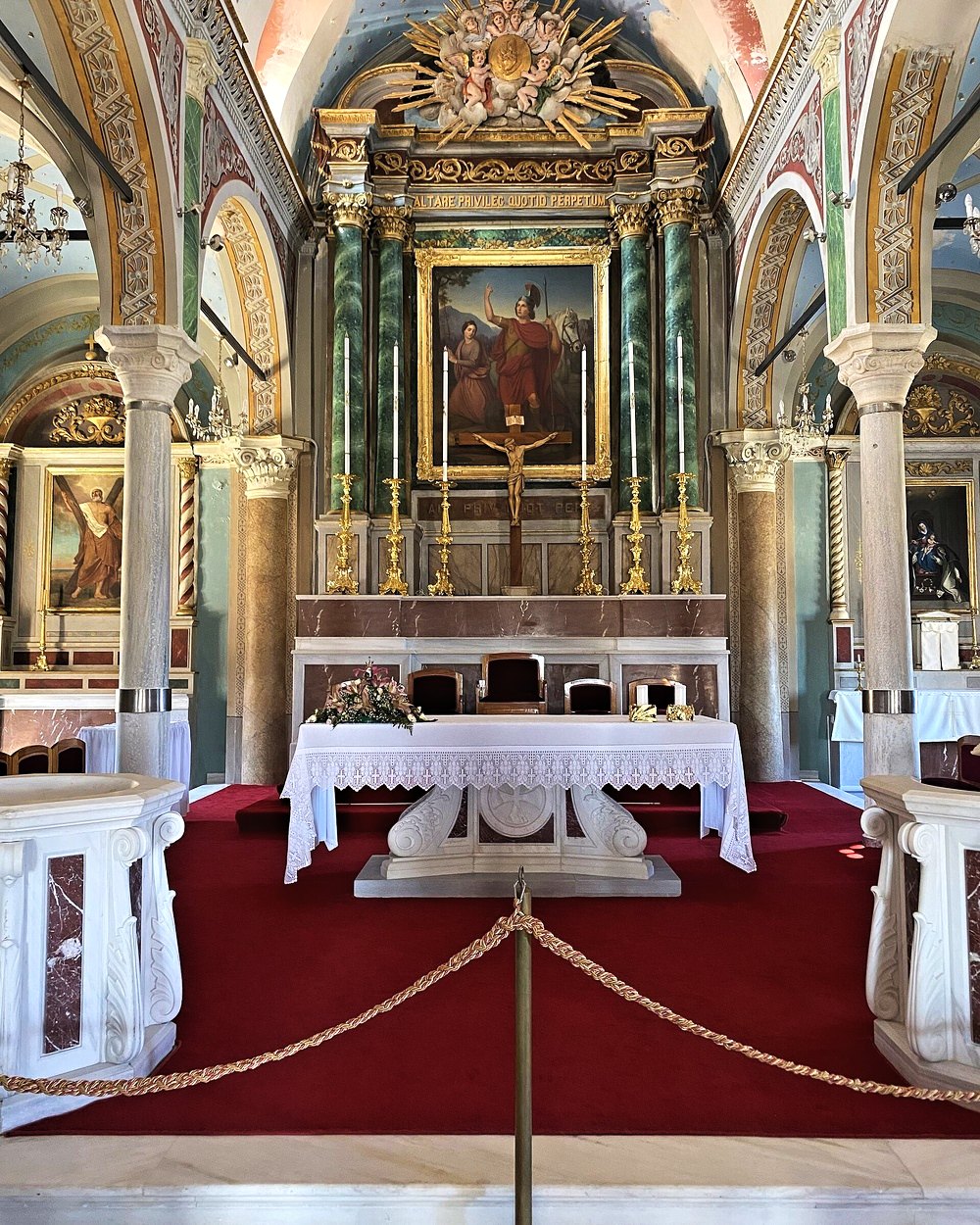
Syros is where Greece’s shared Easter is at its grandest. The island’s Catholic community, descended from Venetian and Genoese settlers, celebrates on the Orthodox date, so for Holy Week the two cathedrals, the Orthodox Metamorfosi in Ermoupoli and the Catholic Agios Georgios on the hill of Ano Syros, keep the same calendar. On Good Friday evening the Epitaphios processions from both communities wind down through the neoclassical streets and the lanes of Ano Syros towards the harbour, where they come together, and the chanting of the two rites overlaps across Miaouli Square. At midnight on Saturday the fireworks go up over the port and the cafés under the arcades stay open for magiritsa.
Good to knowErmoupoli’s bakeries make the island’s halvadopita and loukoumia all year; the Easter tsoureki is worth the queue.
CostFree
WhereErmoupoli and Ano Syros, Syros
Tinos: the Epitaphios goes to the sea
The pilgrimage island, quiet for once, and a procession that ends on the quay.
Tinos belongs to the Virgin, and Easter here has the gravity you would expect from Greece’s great pilgrimage church. On Good Friday evening the Epitaphios from Panagia Evangelistria comes down to the old harbour and meets those of the town’s four parishes at the marble platform on the quay for a shared prayer. Then the Epitaphios of Agios Nikolaos is carried on to the little cove of Kalamia and straight into the sea, priest and chanters wading in with it, while the caiques offshore sound their whistles. Like Syros, Tinos has a large Catholic population, concentrated in the villages of the interior, and the Catholic parishes keep the same date, so the Catholic villages under Exomvourgo – Xinara, Loutra, Tripotamos and the dovecote country of Tarampados – have their own processions, while the marble villages of Pyrgos and Panormos keep the Orthodox ones. It is a far gentler island at Easter than in August.
Good to knowTinos is between two and four hours from Rafina depending on the ferry; combine it with Syros, under an hour further on.
CostFree
WhereChora and the villages, Tinos
Sifnos: lamb in a clay pot
Where Easter is cooked as carefully as it is prayed.
The island that produced Greece’s most famous cookbook writer takes Easter Sunday as a culinary occasion. The dish is mastelo: lamb or kid, cut into pieces, laid on vine twigs in a wide clay pot called a mastelo, doused in red wine and dill and baked slowly in the wood oven on Saturday night so that it is ready for the family after church. Every Sifnos potter makes mastela, and the island’s bakeries fire their wood ovens for the whole village’s pots. Holy Week processions in Apollonia and Artemonas are small and lovely, Kastro’s are the most atmospheric, and on Easter Sunday the tavernas that are open serve mastelo to anyone without a family to join.
Good to knowAsk your hotel or taverna in advance if you want to eat mastelo on the day; it is cooked to order.
CostFree
WhereApollonia, Artemonas and Kastro, Sifnos
Chora, Amorgos: the icon from the cliff
The Panagia comes down from Hozoviotissa, and Chora walks with her.
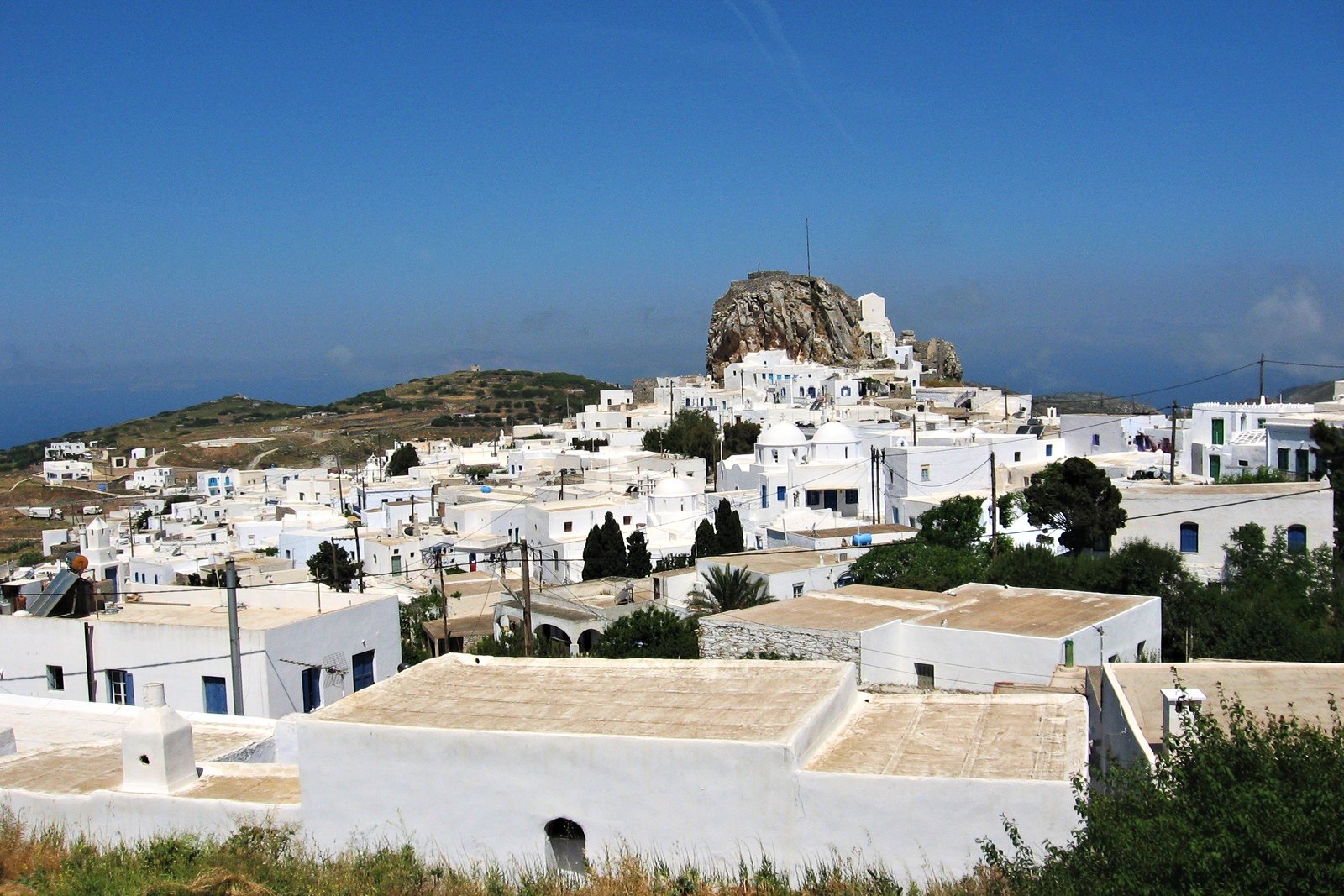
The monastery of Hozoviotissa, wedged into a cliff 300m above the sea, keeps the icon that is the island’s patron, and at Easter she comes to town. On Good Friday night the Epitaphios winds through the lanes of Chora, the white hill village beneath the castle rock, with women scattering cologne from the doorways, and over Easter week the icon from Hozoviotissa is brought down and carried through the village for several days before she goes back up the cliff. The lanes are narrow enough that the whole village is part of the procession whether it means to be or not, and the kafeneia on the Loza square pour psimeni raki, the island’s honeyed spirit, for everyone afterwards.
Good to knowThe Easter ferries from Piraeus are slow and few; fly to Naxos and take the small ferry across if your time is short.
CostFree
WhereChora, Amorgos
Milos: the burning of Judas
Fireworks on Holy Saturday and an effigy that goes up in flames.
Milos adds a note of theatre to Holy Week. On Holy Saturday night the Resurrection fireworks go up across the island, and over the Easter weekend the village of Triovasalos, between Adamas and Plaka, sets an effigy of Judas alight in the square, in a custom that is older than anyone can remember and louder than anyone expects; ask in the village which evening. It is a family night, with the whole village out and the children in charge of the noise. Easter Sunday is lamb at home, so book a taverna in Adamas or Pollonia for lunch, and spend the afternoon at Sarakiniko, where the white rock looks its best in spring light.
Good to knowMilos opens early for the season; most of Adamas’s hotels and tavernas are running by Easter.
CostFree
WhereTriovasalos, Milos
Koronos, Naxos: the feast of Argokiliotissa
The mountain pilgrimage that follows Easter, and the biggest feast on Naxos.
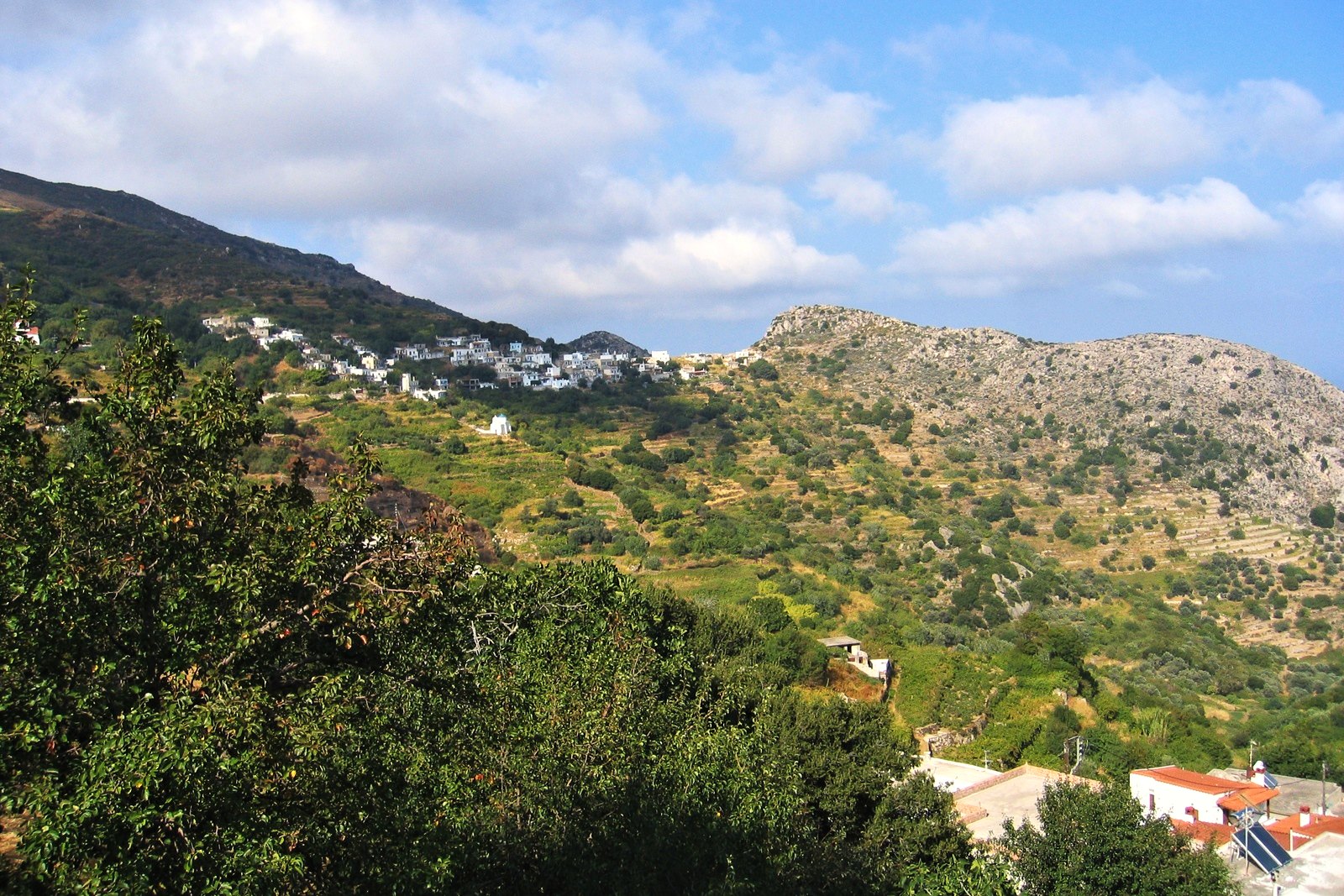
The Friday after Easter Sunday, 7 May in 2027, is the feast of Zoodochos Pigi, the Life-giving Spring, and on Naxos it belongs to Panagia Argokiliotissa, a church high in the mountains above Koronos in the north of the island. Islanders walk up from the village for the service and stay for the feast, which Naxiots call the most significant on the island: wine, local dishes and dancing on the terraces above the valley. Koronos itself, a stack of white houses in a green ravine, is one of the prettiest villages on Naxos and was once the centre of its emery mines. Make a day of it with lunch in Apeiranthos on the way.
Good to knowThe feast falls in Bright Week, when the islands are still in holiday mode; most Naxos hotels are open by then.
CostFree
WherePanagia Argokiliotissa, above Koronos, Naxos
The Easter table
What you’ll eat, and where the islands differ.
The national menu is fixed: magiritsa after midnight on Saturday, lamb or kid on the spit and kokoretsi, the seasoned offal wound in intestine, on Sunday; red eggs, tsoureki and koulourakia, the twisted butter biscuits, all weekend. The islands add their own. Santorini bakes melitinia, small open tarts of sweet mizithra and mastic. Sifnos cooks its lamb in the mastelo and makes melopita, a honey and cheese pie. Syros puts out halvadopita and loukoumia. Naxos sets its graviera and kitron beside the lamb. Good Friday, by contrast, is a fast: lentil soup with vinegar, bread, olives, and in the tavernas a short lenten menu that is often the best-cooked food of the week.
Good to knowTavernas that open on Easter Sunday usually offer a set lunch; book a day ahead.
Good to know
The practical bits.
Book ferries and rooms by March; Easter weekend is the first big surge of the year and Athenians head for the islands in numbers. Shops close on Good Friday until the afternoon and on Easter Sunday, and some close Easter Monday. Churches welcome visitors at every service; dress modestly, buy a candle at the door, stand where you like and leave when you like. On Saturday night bring a candle for the Holy Light, keep it alight to your door and let it smoke a cross on the lintel. Learn the two phrases: Christos Anesti to anyone you meet after midnight, Alithos Anesti in reply. And eat lamb.
You might also like
- What’s On in the Cyclades 2027
- Panigiria: The Saints’ Day Feasts of the Cyclades
- When to Go to the Cyclades
Prices and opening times are approximate and change with the season. If something has changed, let us know.