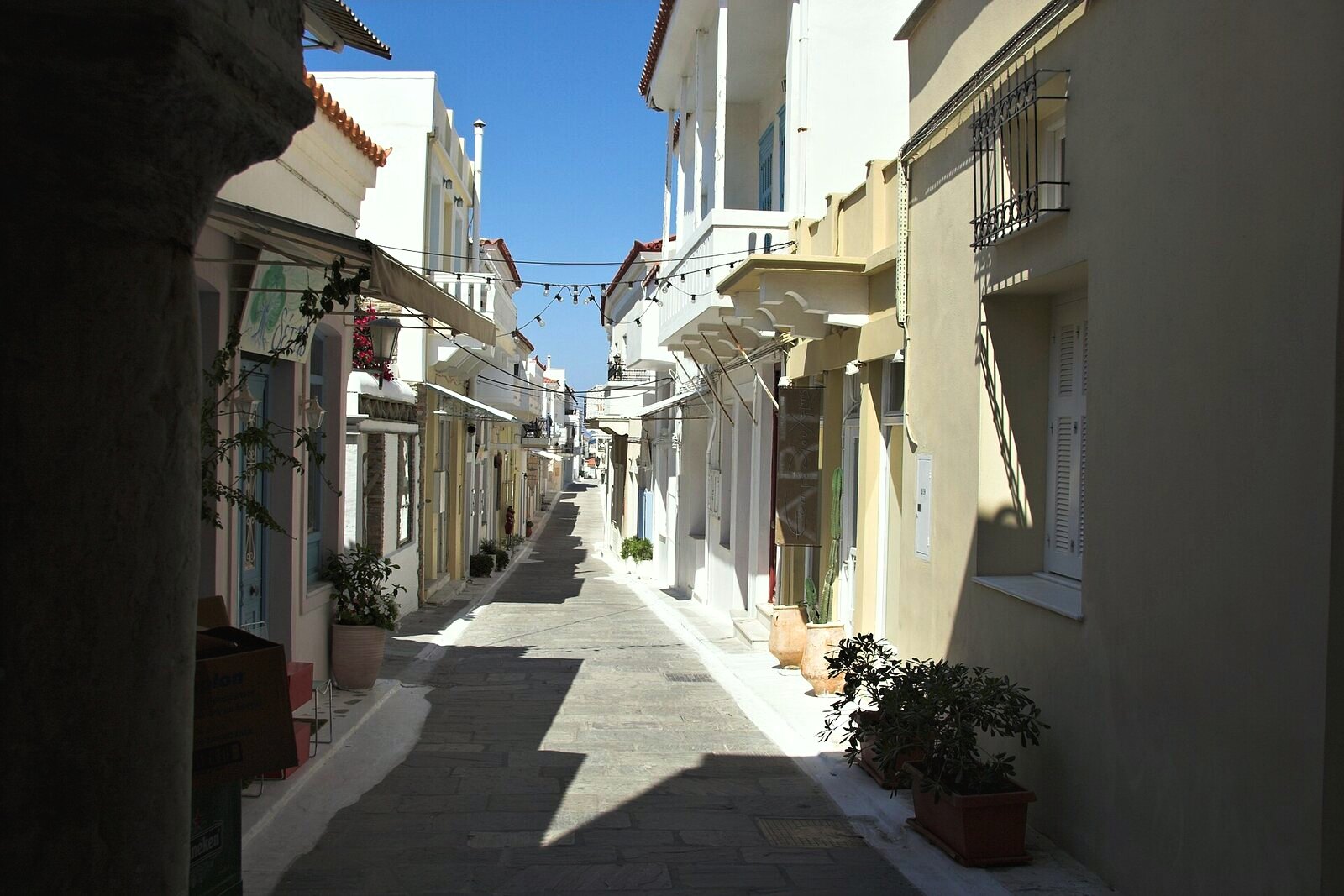
The three northern islands sit in a line between Rafina and Mykonos, and a week among them is a different Cyclades from the one on the postcards. Syros gives you a 19th-century city with a sea to swim in. Tinos gives you villages, marble, dovecotes and a church that half of Greece walks to. Andros gives you water, woods and footpaths. Syros and Tinos are about half an hour apart by ferry and Tinos and Andros about an hour and a half, so you can string these twelve together in a loop from Athens and never queue for a sunbed. Prices are approximate and seasonal.
Walk Ermoupoli and Step Inside the Apollo Theatre
Marble pavements, a Ziller town hall, and a little La Scala on the square.
Start at the harbour and walk up through streets paved in marble to Miaouli Square, the grandest public space in the Cyclades: palms, a bandstand, and the Town Hall designed by Ernst Ziller filling one side. Behind it, on Vardaka Square, stands the Apollo Theatre, built in 1864 by the Italian architect Pietro Sampo as a small-scale version of Milan’s La Scala. It opened with Verdi and Donizetti, declined into a cinema, and was restored in 2000. You can usually look inside at the painted ceiling and tiers of boxes from Tuesday to Saturday, 10am to 2pm, and in summer there are concerts. Carry on uphill into the lanes of neoclassical houses with their pastel shutters and iron balconies, and let yourself get lost.
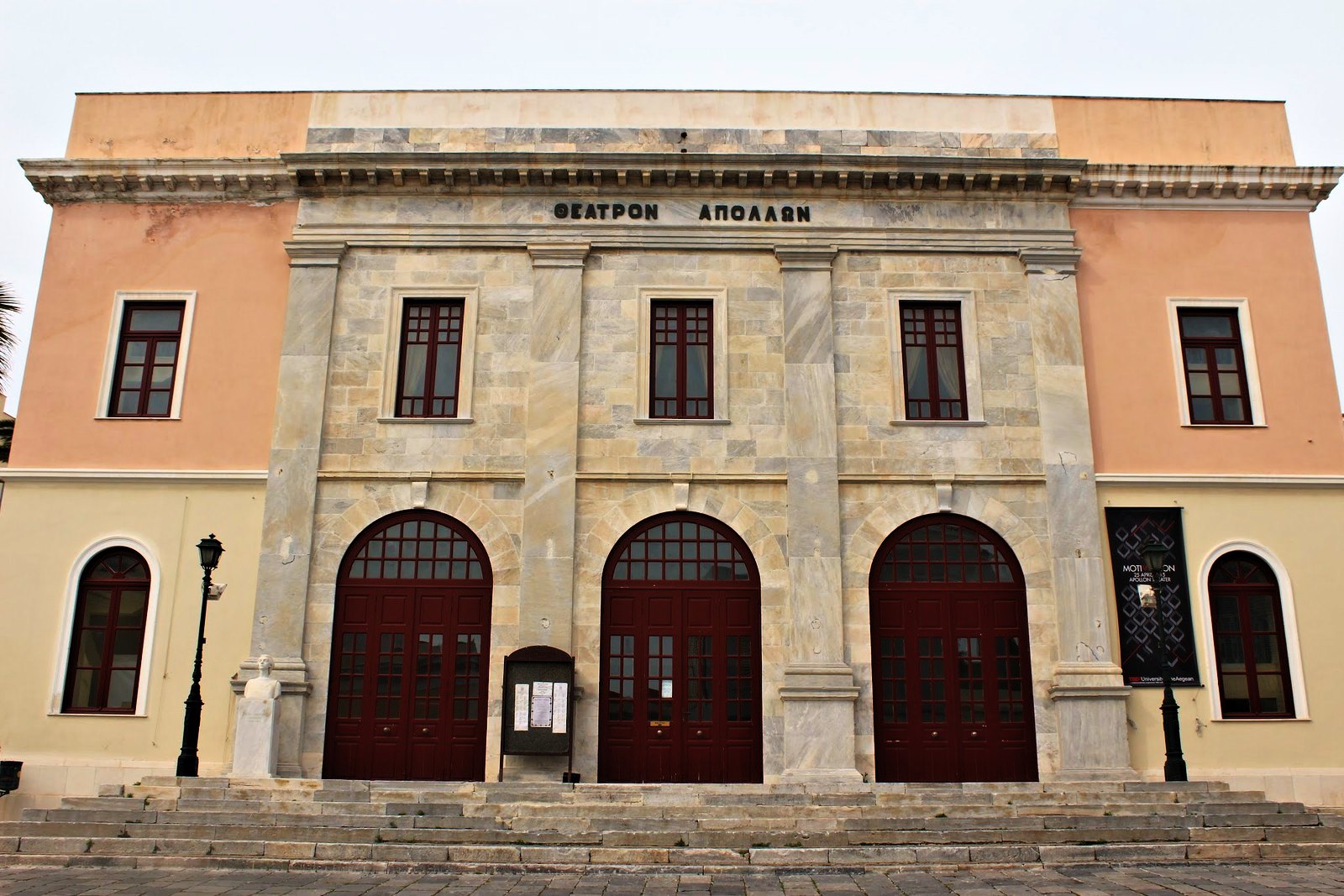
Good to knowThe Festival of the Aegean brings opera and concerts to the theatre each summer, usually in the second half of July (in 2026 it ran from 27 July to 2 August).
WhereErmoupoli, Syros
ContactFind it on Google Maps
Climb to Ano Syros
A thousand steps, a Catholic cathedral, and the ghost of a rebetiko singer.
Above Ermoupoli, a second town climbs its own hill: medieval, Catholic, whitewashed, built in stepped lanes under arches that keep out the wind. Ano Syros was here centuries before the port below, and feels it. Climb from Ermoupoli (allow 20 minutes and a lot of steps, or take the bus) to the cathedral of Agios Georgios at the top for a view over both towns and the harbour. On the way, you pass the house of Markos Vamvakaris, the father of rebetiko, who was born here in 1905; there is a small museum and a statue in the square that bears his name. Come at dusk, drink something in the lanes, and walk down with the lights of Ermoupoli below.
Good to knowWear proper shoes; the steps are steep and polished.
WhereAno Syros, Syros
ContactFind it on Google Maps
Swim at Vaporia
Mansions above, ladders down, the sea ten minutes from breakfast.
Vaporia is the quarter of Ermoupoli where the 19th-century ship-owners built their houses right on the water, and below them the rocks and concrete platforms have been the town’s swimming spot ever since. Walk past the blue dome of Agios Nikolaos, find the steps down, and lower yourself into clear deep water with neoclassical facades for a backdrop. There is no sand and no beach bar, just locals with towels and a few ladders, which is the charm. Dry off at a café on the terrace above and look back at where you were. For a town swim, nothing in the Cyclades comes close.
Good to knowWater shoes help on the rocks; mornings are calmest.
CostFree
WhereVaporia, Ermoupoli, Syros
ContactFind it on Google Maps
Watch the Sun Set at Kini
A fishing village, a crescent of sand, and the one direction Syros faces west.
Kini is ten minutes by road from Ermoupoli and on the opposite side of the island in every sense: a small fishing harbour, a sandy beach, tavernas with tables on the sand, and a view straight into the setting sun. Swim first, then take a table at one of the tavernas on the sand an hour before dusk. If you want to earn it, walk the coastal path north from Kini to Delfini beach, a bigger, wilder bay about 20 minutes away, and come back for supper. Buses run from Ermoupoli; the last one back leaves after dark in summer, but check.
Good to knowKini sits in the lee of the meltemi, so it is a good bet on windy days.
WhereKini, Syros
ContactFind it on Google Maps
Pay Your Respects at Panagia Evangelistria
The Lourdes of Greece, a carpeted road, and an icon found in 1823.
The church of the Annunciation dominates Chora on Tinos, and the wide street that runs up to it from the port has a strip of carpet along one side for pilgrims who make the climb on their knees. The icon, said to be miraculous, was found in 1823 after a nun named Pelagia dreamed of its location, and the marble church built over the spot, finished in 1830, is the greatest pilgrimage site in Greece. Inside, votive offerings hang in their thousands: silver ships, hearts, legs, eyes. Below the church, the chapel marks the spot of the discovery. Dress modestly, go early or late to avoid tour groups, and on 15 August stand back and watch the whole island arrive.
Good to knowShoulders and knees covered; busiest on 25 March and 15 August.
CostFree
WhereChora, Tinos
ContactFind it on Google Maps
Wander the Boulders of Volax
Granite spheres the size of houses, and old men weaving baskets between them.
Eleven kilometres inland from Chora, the road drops into a plateau scattered with round granite boulders, some as big as cottages, and a village built among them. Geologists blame weathering and wind over an unimaginable stretch of time; locals have simply built their houses against the rocks and got on with it. Volax has a long tradition of basket-weaving and you can still buy a basket from a maker in the lanes. There is a small folklore museum by the church, a stone open-air theatre used for summer events, and tavernas and cafés in the square for lunch. Climbers come for the bouldering. Everyone else comes to wonder.
Good to knowCombine with the dovecotes at Tarampados and the villages of the central plateau.
WhereVolax, Tinos
ContactFind it on Google Maps
Pyrgos and the Museum of Marble Crafts
A village made of marble, and a museum that shows how it got that way.
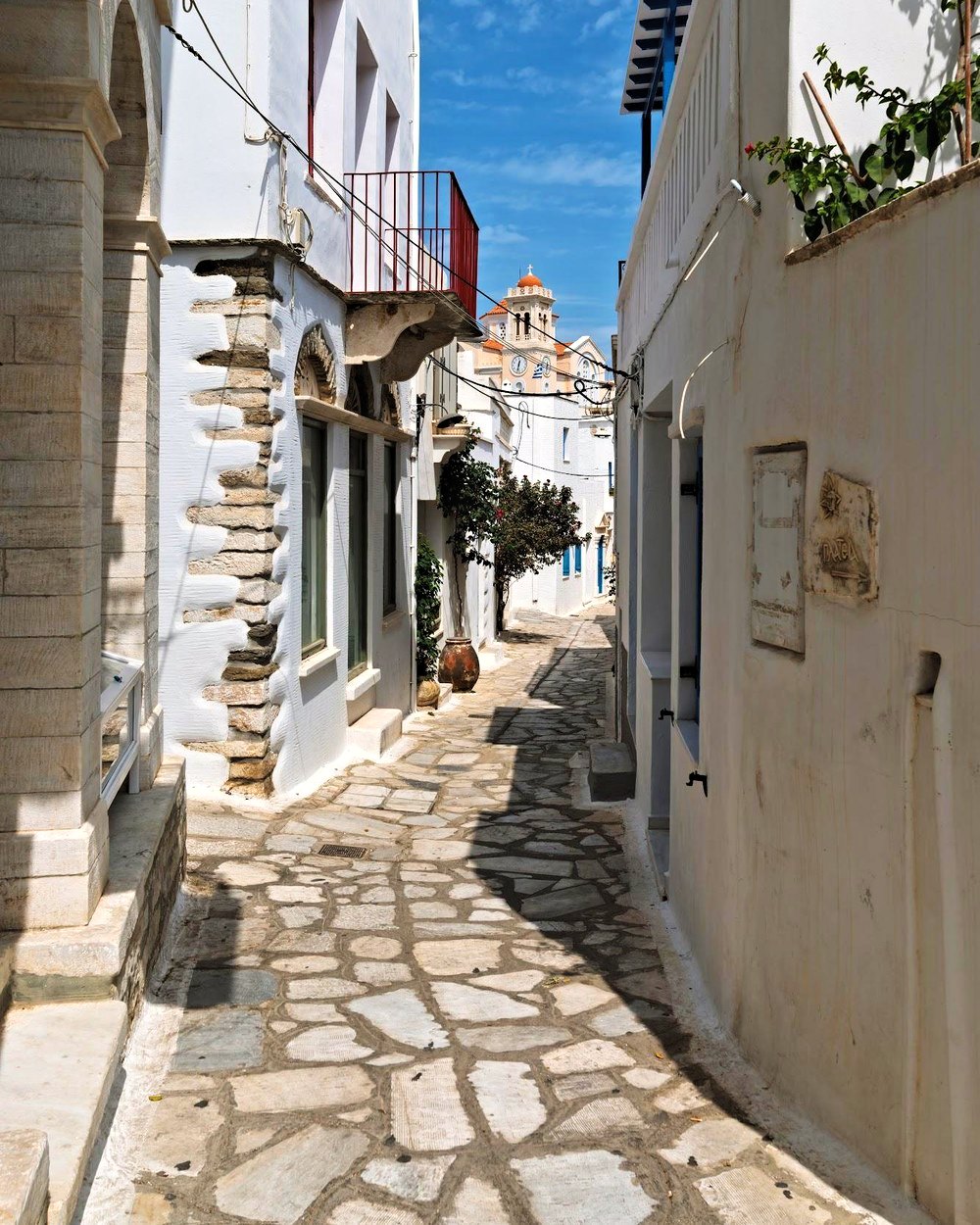
Pyrgos, in the north of Tinos above the bay of Panormos, is the marble village: marble fountains, marble fanlights carved over every door, a marble square shaded by a plane tree. It produced the sculptors Yannoulis Chalepas and Dimitrios Filippotis and still houses a school of fine arts and working studios. Just outside the village, the Museum of Marble Crafts, run by the Piraeus Bank Group Cultural Foundation, follows the stone from quarry to finished work: the tools, the hoists, the clay models, the half-carved pieces, with films of the old techniques. Afterwards, visit Chalepas’s house in the village and walk down to Panormos for a swim and lunch on the quay.
Good to knowClosed on Tuesdays; open 10am to 6pm from March to mid-October and to 5pm in winter.
Cost€8, concessions €4, under-18s free
WherePyrgos (Panormos), Tinos
ContactFind it on Google Maps
Count the Dovecotes of Tarampados
Slate lace in a green valley, built for pigeons by the Venetians.
Tinos has somewhere between 600 and 1,000 dovecotes, two-storey towers of schist whose upper floors are decorated with triangles, diamonds and circles of slate laid like lace. The Venetians, who held the island until 1715, introduced dove-breeding, and the towers supplied both meat and manure to the terraced farms around them. No two patterns are the same. The valley below Tarampados, on the plateau near Volax, has about twenty restored dovecotes within a short walk of each other and is the best place to see them close up; others cluster around Komi, Krokos and Kardiani. Go in the late afternoon when the sun picks out the carving.
Good to knowA marked path leads from the village into the valley; allow an hour.
CostFree
WhereTarampados, Tinos
ContactFind it on Google Maps
Swim at Kolymbithra
Two bays side by side: one for surf, one for stillness.
Kolymbithra on the north coast of Tinos is really two beaches separated by a headland. The big one is wide and open, with a beach bar, loungers and, when the meltemi blows, waves good enough for surfing; the small one is a sheltered cove of fine sand and shallow water, perfect for children and for mornings. Both face north, so this is a beach for calm days or early starts in high summer, and an all-day paradise in June and September. The drive from Chora through the central villages is half the pleasure. Bring an umbrella for the small bay; shade is scarce.
Good to knowExposed to the meltemi; check the wind before setting out in July and August.
WhereKolymbithra, Tinos
ContactFind it on Google Maps
Climb Exomvourgo
A granite peak, a ruined Venetian capital, and the whole island at your feet.
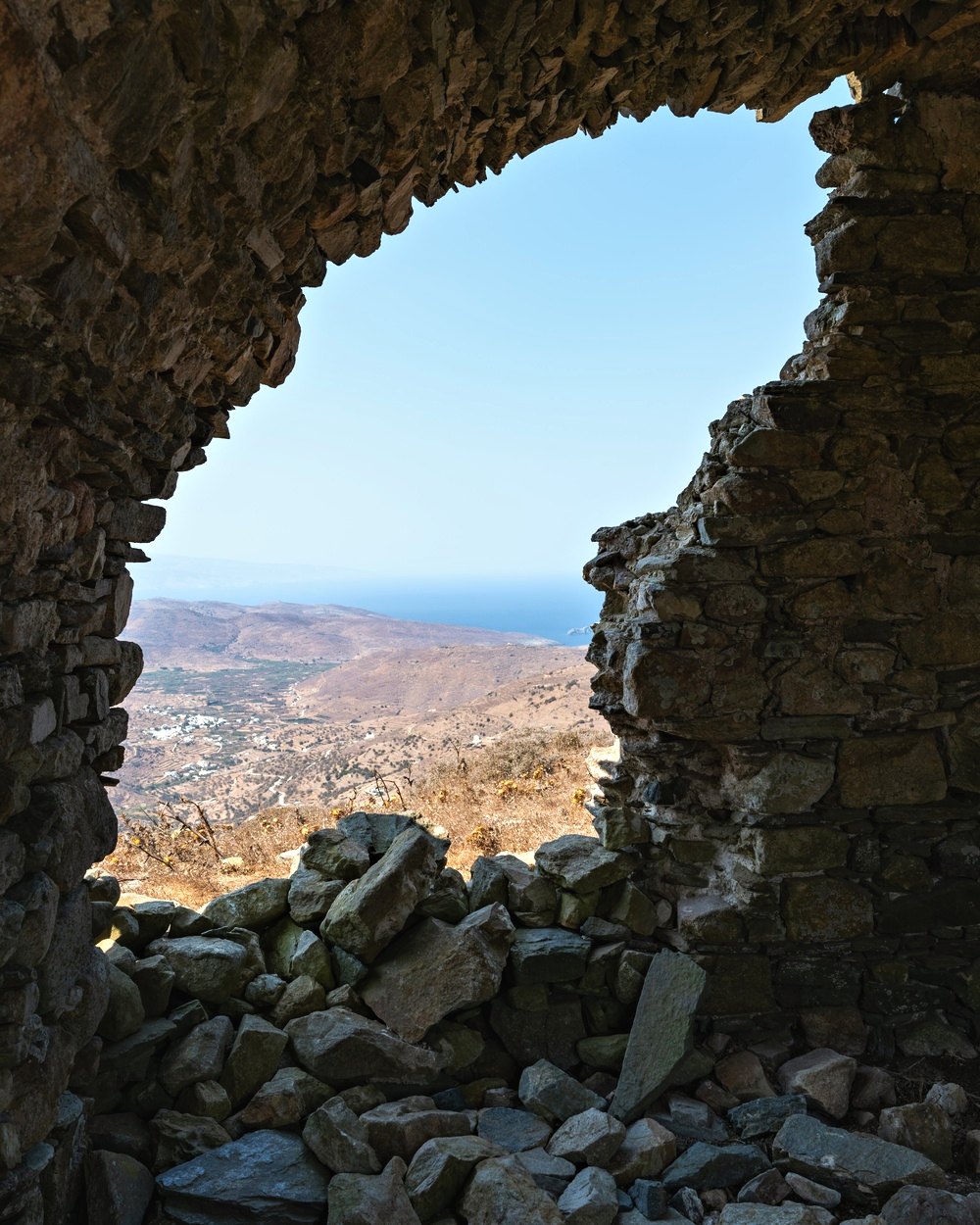
Exomvourgo is the granite dome in the middle of Tinos, about 640 metres high, and on its summit are the ruins of the fortified town that was the island’s capital under Venice until the Ottomans took it in 1715. A path climbs from the road near the Catholic monastery below, steep in places, through thyme and rock to the walls. From the top you see the whole island, the dovecote valleys, the villages, the sea on three sides and, on a clear day, Syros, Mykonos and Andros. Go early or late; there is no shade, and the wind up here is something to respect. Allow an hour up and down from the monastery, longer if you linger on the walls.
Good to knowNot one for windy afternoons; carry water.
CostFree
WhereExomvourgo, central Tinos
ContactFind it on Google Maps
Walk the Andros Route to the Pythara Waterfalls
Old mule paths, plane trees, running water in the Cyclades.
Andros Routes, a volunteer group, has restored and signed more than 240 kilometres of old paths on the island, and the 100-kilometre Andros Route, end to end, was the first island trail in Europe to be certified a Leading Quality Trail. The classic half-day is Route 2: it starts at the Chora bridge, climbs the Louri valley to Apikia, home of the Sariza spring, then takes the 2a detour along the stream into the woods to the Pythara waterfalls, pools and cascades under plane trees at their best from spring to early summer. Allow about three hours for the 8 kilometres, and lunch in Apikia; Route 8 brings you back down through the sea-captains’ village of Stenies to the beach at Gialia. The full route is a week’s walking in stages.
Good to knowBest from April to June and late September to October; carry water and good shoes.
CostFree
WhereChora to Apikia, Andros
Contactandrosroutes.gr
Andros Chora and the Goulandris Museum
A shipowners’ town on a peninsula, with a Goulandris-funded museum whose summer show changes each year.
Chora on Andros is built on a narrow rocky peninsula between two beaches, and its marble-paved main street runs from the bus stop through neoclassical mansions to Kairis Square and a stone bridge to the Venetian castle ruin at the tip, where a bronze Unknown Sailor faces the sea. The town was built by shipping families, and one of them, the Goulandris, founded the Museum of Contemporary Art here in 1979. Its permanent collection is built around the sculptor Michael Tombros, whose family came from Andros, and its summer exhibitions have brought Picasso, Matisse, Kandinsky and Klee to a village of two thousand people. See the museum, then the Maritime Museum, then swim at Paraporti below the castle.
Good to knowThe big exhibition runs from mid-June to late September and changes every year (2026 was Germaine Richier); the 2027 show had not been announced at the time of writing, so check the programme before you go, and whether the New Wing, closed for works in 2026, has reopened; closed Tuesdays.
Cost€8, concessions €5, under-12s free
WhereChora, Andros
ContactFind it on Google Maps
You might also like
- Syros: The Capital Nobody Told You About
- Tinos: Marble Villages, Dovecotes and Serious Food
- Andros: Walking Island of Springs and Shipowners
Prices and opening times are approximate and change with the season. If something has changed, let us know.