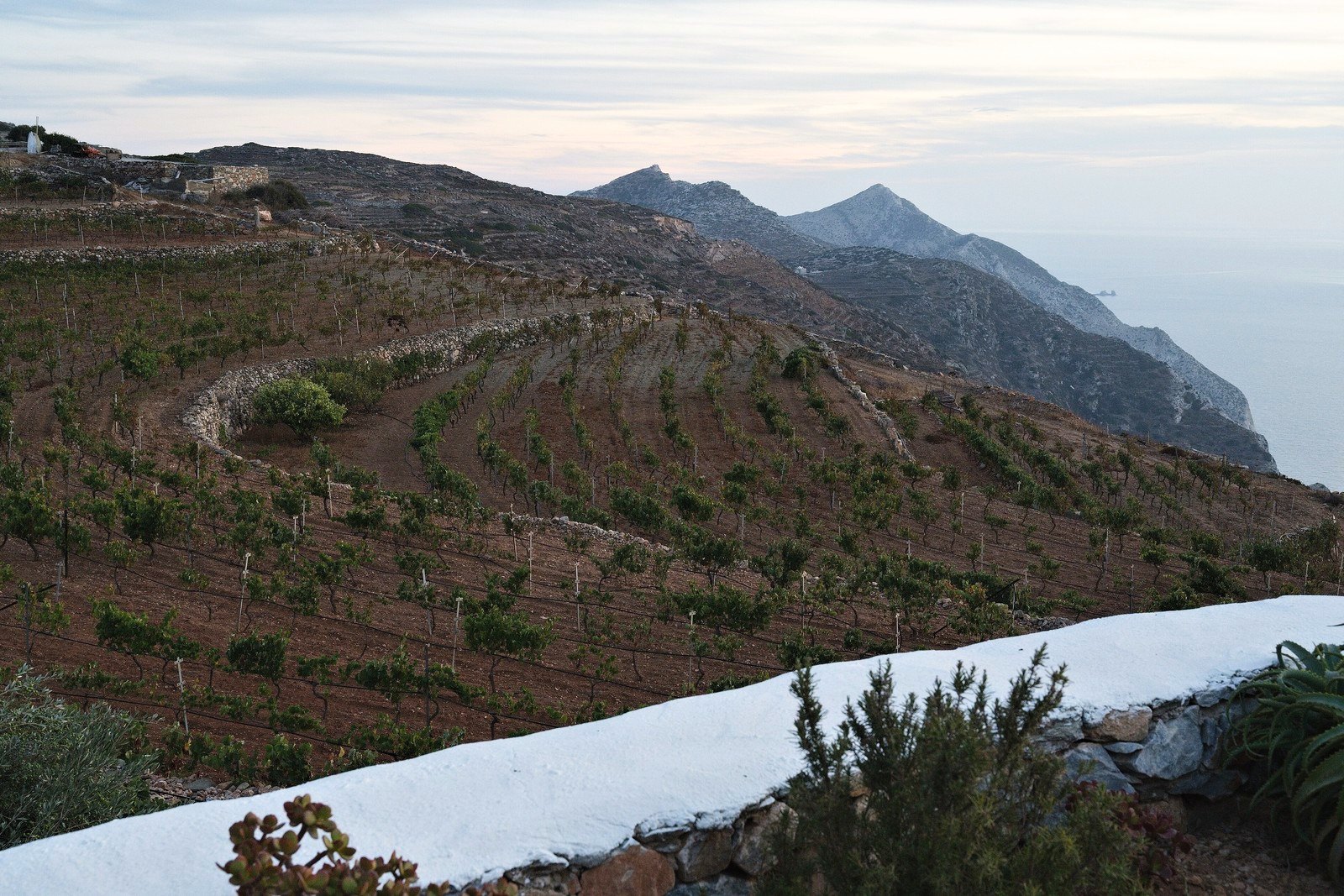
Granite sand. A low stone terrace. A vine bent almost flat by the meltemi. Santorini takes the fame, but wine is made all over the Cyclades, much of it from old island grapes you will never see on a wine list at home – Mavrotragano and Rozaki on Tinos, Monemvasia and Mandilaria on Paros, Serifiotiko on Syros – and most of it in quantities so small that it barely leaves the island it was grown on. The wineries are family places, a few of them only a decade old, and many open only in summer and only if you book. This is where to taste, island by island. Prices and hours are the wineries’ own and change with the season, so check before you go, and pack the bottles you buy wrapped in clothes in your hold luggage.
Santorini: Start Here
Assyrtiko in baskets on volcanic ash.
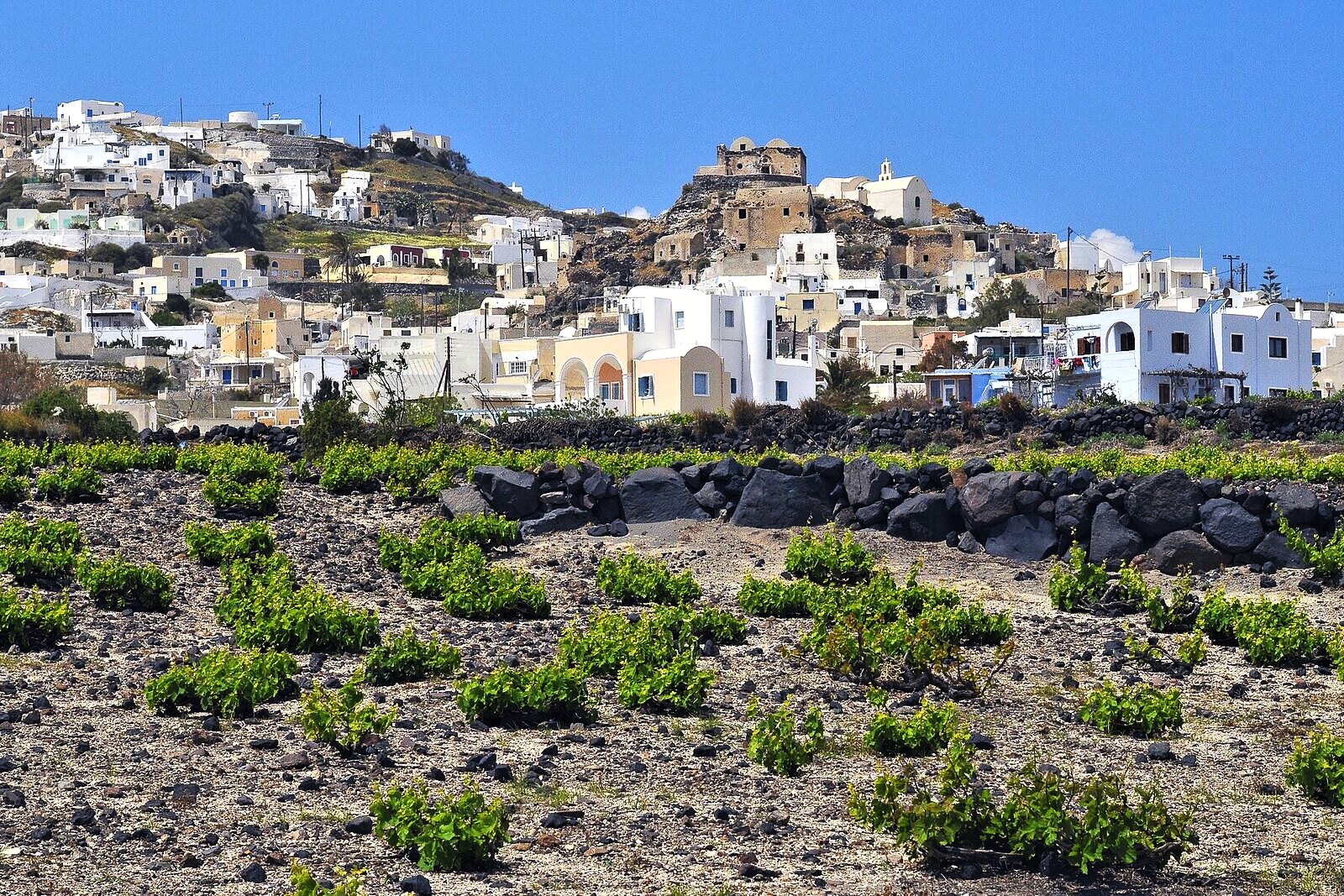
Santorini is the great wine island of the Cyclades. Its vines grow in pumice and ash, trained into low baskets, the kouloura, to keep them out of the wind, and they give Assyrtiko, the dry white with the salt of the sea in it, and Vinsanto, the sun-dried sweet wine aged for years in barrel. The island’s cellars have a guide of their own, The 8 Best Wineries in Santorini; keep a day for them, then come and find the islands below.
Tinos: Granite and the Meltemi
A wine island again, after four centuries.
Tinos made wine in antiquity, lost most of its vineyards when the Venetians uprooted them in the early seventeenth century, and very nearly lost the rest in the twentieth. In the last twenty years the vines have come back, above all around Falatados in the middle of the island, where they grow in granite sand among the boulders and take the full force of the summer wind; the harvest comes about a month after Santorini’s. On wine lists, look out too for Domaine de Kalathas, Jérôme Binda’s natural wines from old Aspro Potamisi and Rozaki vines; it has no cellar door to visit.
T-Oinos: Falatados, Tinos
Assyrtiko on granite, Mavrotragano on schist.
Alexandre Avatangelos and Gérard Margeon, the sommelier long associated with Alain Ducasse, planted their first vines above Falatados in 2002 and 2003, and T-Oinos is now the island’s best-known estate. There are two grapes: Assyrtiko in the granitic sand of the Clos Stegasta vineyard, and Mavrotragano, Santorini’s rare red, on schist at Rasonas, with the Bordeaux winemaker Stéphane Derenoncourt advising since 2015. Visits are booked tastings among the vines, about two hours long: the Discovery Experience, with three wines, is €70 a head; the Indigenous Icons is €110; and the Absolute Experience, which adds the Rasonas vineyard and a short vertical tasting, is €140.
Good to knowVisits run daily between 8am and 8pm, by booking only; you need your own car to get there.
WhereFalatados, Tinos
Volacus: Falatados, Tinos
Vines between the boulders, and a table in the yard.
Michalis Kontizas and his wife Eirini planted their vineyard among the round granite boulders – the volakes the winery is named after – and made their first harvest in 2016. It is a family place, farmed organically, making Assyrtiko, Malagousia, Rozaki and Mavrotragano in small quantities, and visitors taste at a shaded table in the courtyard with the boulders all around. Of the two Falatados wineries this is the informal one, and the one to choose for a long evening glass rather than a lesson.
Good to knowOpen May to September on Mondays, Wednesdays and Fridays, 5.30–8.30pm, by request; book by phone or WhatsApp on +30 697 309 5245.
WhereFalatados, Tinos
Paros: Monemvasia and Mandilaria
The island’s own appellation, and a red made with a white grape.
Paros has its own protected designation of origin. The white is Monemvasia, floral and fresh; the red is built on Mandilaria, the dark, tannic Aegean variety, which the island’s rules blend with white Monemvasia. All three wineries below lie on or near the road from Naoussa to Marpissa, so they make an easy day.
Moraitis: Naoussa, Paros
Four generations beside the beach.
Manolis Moraitis planted his first vines in 1910, and the family’s winery still stands beside Agioi Anargyroi beach outside Naoussa. The fourth generation now farms some ten hectares of its own vineyards, organically, with both well-known and rare native varieties of the island, and makes Paros wines from Monemvasia and Mandilaria that are the island’s table wines done properly.
Good to knowArrange a visit by email (visit@moraitiswines.gr); the winery is a short walk along the coast from Naoussa harbour.
WhereNaoussa, Paros
Ktima Roussos: Asteras, Paros
A new winery on an old family vineyard.
Konstantinos Roussos took on the vineyards his father and grandfather worked and opened the winery in 2017, on about fifteen hectares near Asteras. Alongside the classic Paros pair he grows Malagousia, Assyrtiko and both the white and black forms of Aidani, and the estate red blends Mandilaria with black Aidani. The tasting is five wines with local delicacies on a terrace above the vines.
Good to knowOpen daily, 8am – 7pm (last entry 5.30pm), except Easter Sunday and 15 August; book online or on +30 22840 51798.
WhereAsteras, Paros
Louridis: Marpissa, Paros
A family winery and distillery on the east side of the island.
Sofia and Nikos Louridis set up their winery, distillery and bottling line in Marpissa in 2008, with vineyards on the east side of the island. They make the two Paros wines – a white from Monemvasia and a red from Mandilaria and Monemvasia – and the tasting adds their sun-dried liasto and rakomelo, all of it their own.
Good to knowOpen daily, 9am – 2pm and 6.30–8.30pm; ring ahead on +30 697 494 7740 before you drive over.
WhereMarpissa, Paros
Naxos: A Chapel in the Vineyard
The island’s one winery tour, in the Potamia valley.
Naxos is better known for its cheese and its kitron than for its wine, and only one of its wineries gives tours.
Saint Anna Winery: Kato Potamia, Naxos
A ninth-century church in the middle of the vines.
Emmanuel Petrakis founded Saint Anna in 2016 on his family’s land in the green Potamia valley, about 7.5 kilometres from Naxos Town on the road to Chalki. The visit starts at the Byzantine church of Agia Anna, built in the ninth century and still standing in the middle of the vineyard, moves on through the small stone winery, and ends with a tasting and plates of island food outside. The estate is farmed organically and grows Fokiano, Mandilaria, Monemvasia and Savatiano.
Good to knowThe winery lists its hours as Monday to Saturday, 9am – 6pm; book the tour ahead in summer.
WhereKato Potamia, on the Naxos–Chalki road, Naxos
Mykonos: A Farm Behind the Party
Organic vines outside Ano Mera.
Mykonos Vioma: Ano Mera, Mykonos
An old monastery vineyard, farmed as a family farm.
Nikos Asimomytis founded Vioma in 1994 on an old monastery vineyard outside Ano Mera, and the family still farms it organically, along with a working farm. The grapes are Assyrtiko, Athiri, Monemvasia, Malagousia, Agiannitis and Mandilaria, and the wines include Paraportiano, white and red, a Mandilaria rosé and a sweet wine, Heliophilos. The wine-and-farm visit is the most restful afternoon on the island, and in late August you can join the harvest and tread the grapes.
Syros: Serifiotiko
Old, ungrafted vines and a grape from the next island.
Syros has a handful of small new wineries, and they are reviving Serifiotiko, a white grape from Serifos that grows on the island on old, ungrafted vines.
Para Kopois: Parakopi, Syros
A third-generation grower and a sweet wine three years in oak.
Petros Roussos, the third generation of his family to grow grapes here, and Anezoula Nomikou founded Para Kopois in 2018 on 2.8 hectares below Gerousi hill, where the oldest vines are more than fifty years old and ungrafted. They make Serifiotiko, Roditis and Mandilaria into a range that runs from Nisou Methi, a crisp white, through Single, from ungrafted Serifiotiko alone, to Ambito, a sweet wine aged for thirty-six months in oak. The basic tasting is three wines in about an hour and a half (€22); the premium adds Ambito and runs to two hours (€35).
Good to knowTastings are by booking only, through the website or on +30 697 498 9560; there are children’s prices and dogs are welcome.
WhereParakopi, Syros
Ousyra: Chroussa, Syros
A tasting among the oldest vines on the island.
Ousyra is a family winery in the green village of Chroussa that has built its name on ungrafted Serifiotiko: its single-vineyard amphora wine, SIA, comes from just 359 vines and runs to a few hundred bottles. There is also a rosé from Fokiano. The tour ends with a tasting in the ungrafted vineyard itself, about an hour and a half, at €40 a head for two people or €35 a head for three or more.
Good to knowSummer tastings on Thursdays and Fridays, 3.30–5pm; booking is essential.
WhereChroussa, Syros
Milos: A Cellar in the Rock
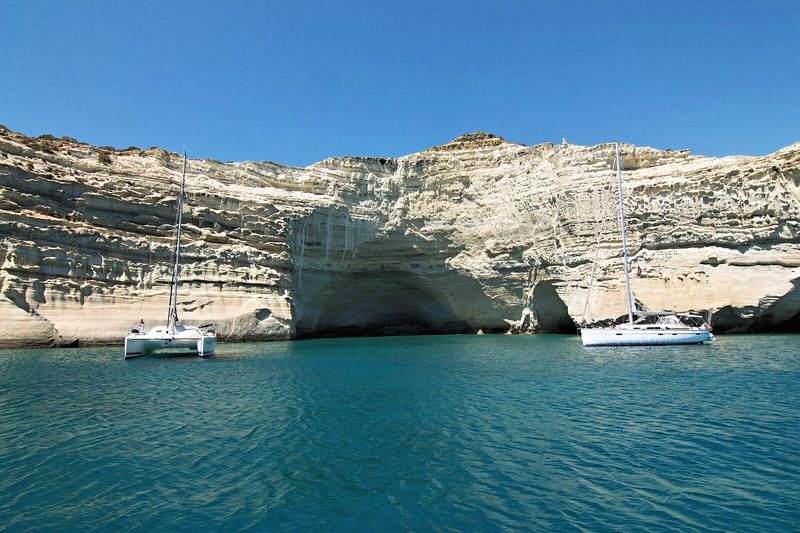
Volcanic soil and a cave for the barrels.
Kostantakis Winery: Pollonia, Milos
A grandson’s winery on his grandfather’s vineyard.
The Mallis family planted their vineyard outside Pollonia in 1935, and Kostas Mallis, the founder’s grandson, turned it into a winery, with its first bottling in 2013 and the cellar in a volcanic cave. The four hectares grow Assyrtiko, Monemvasia, Mavrotragano, Aidani, Mandilaria and more, and the wines include the Spilia (cave) range and a retsina. The two-hour tour walks the vines, goes into the cave and finishes with eight wines and a grape spirit, with appetisers, for €55 a head.
Good to knowOpen May to October, noon to 9pm; book the guided tour online, up to eight people an hour.
WherePollonia, Milos
Sikinos: Sunset Over the Vines
The wine island of antiquity, and one winery on its terraces.
Manalis Winery: above Chora, Sikinos
Solar power, dry terraces and Folegandros on the horizon.
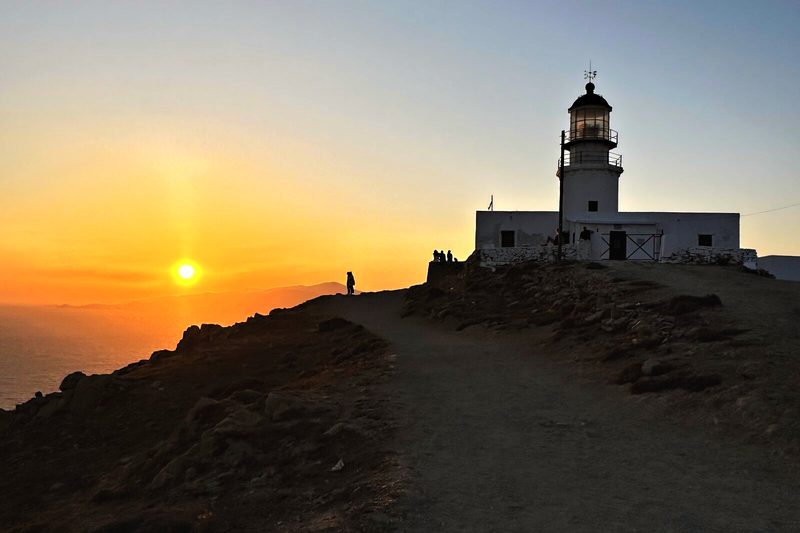
In antiquity Sikinos was called Oinoi, the island of wine, and its vineyards were largely abandoned after the 1970s. Giorgos and Maria Manalis started their cellar in 2008 on dry-farmed terraces at 380–430 metres, two kilometres west of Chora, and run it on solar power. The wines – white, red and rosé, an Assyrtiko, an Aidani, a Mavrotragano and a sweet Liosato – are poured from six in the evening as the sun drops behind Folegandros. Tasting A is four younger wines (€14), Tasting B four older and oak-aged ones (€18), with no booking needed, and there is a restaurant, Strofylia, beside the vines.
Good to knowOpen daily from 15 May to 15 October. The 30-minute walk through the vines starts at 6pm (€10) and should be booked by email two or three days ahead.
WhereTwo kilometres west of Chora, Sikinos
You might also like
- The 8 Best Wineries in Santorini
- The 10 Best Things to Bring Home from the Cyclades
- Cyclades Crafts, Island by Island: Who Makes What, and Where to Buy It
Prices and opening times are approximate and change with the season. If something has changed, let us know.