Clay on the wheel. Marble dust in a doorway. A loom clacking in a back room. Each island in the Cyclades once made what it needed from what it had: Sifnos had clay that fires hard, so its potters sailed the Aegean selling cooking pots; Tinos had marble, so Pyrgos carved it; the mountain villages of Naxos wove. Much of that has gone, but not all of it, and what survives is the best thing you can carry home – made by hand, by someone you can meet, on the island where the material came out of the ground. This guide goes craft by craft. Our 10 Best Ceramics and Craft Shops in the Cyclades covers the best-known names, Atsonios and Lemonis on Sifnos, Yria on Paros and the sandal-makers of Mykonos; these are the makers to add to them.
Pottery: Sifnos and Serifos
Clay that holds the heat, and the families who still work it.
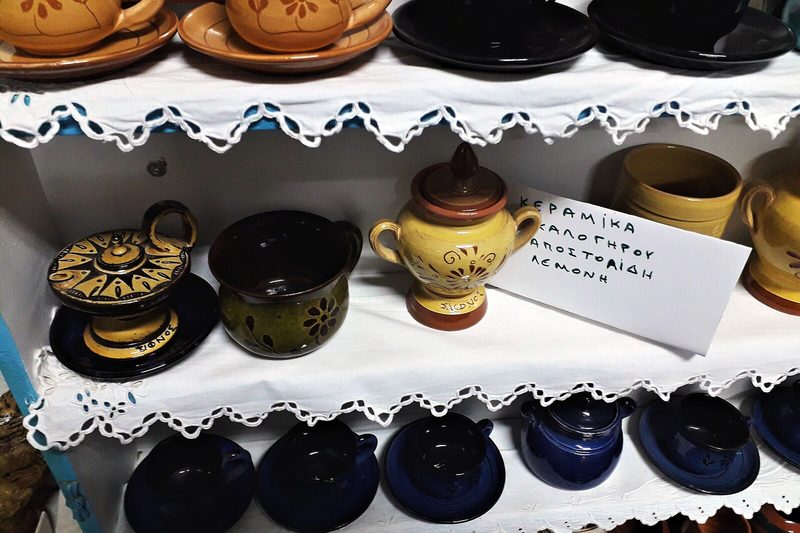
Sifnos is the potters’ island. Its clay fires hard and keeps its heat, which is why revithada – chickpeas baked overnight in a lidded skepastaria – was born here, and why the workshops still make the tsikali for stews and the mastelo for Easter lamb. The island’s own website lists fifteen workshops, and some of the families behind them are four and five generations in. Across the water, Serifos has one studio worth the ferry on its own. Wherever you buy, ask whether a cooking pot has been fired for the oven, and pack it wrapped in a towel in your hold luggage.
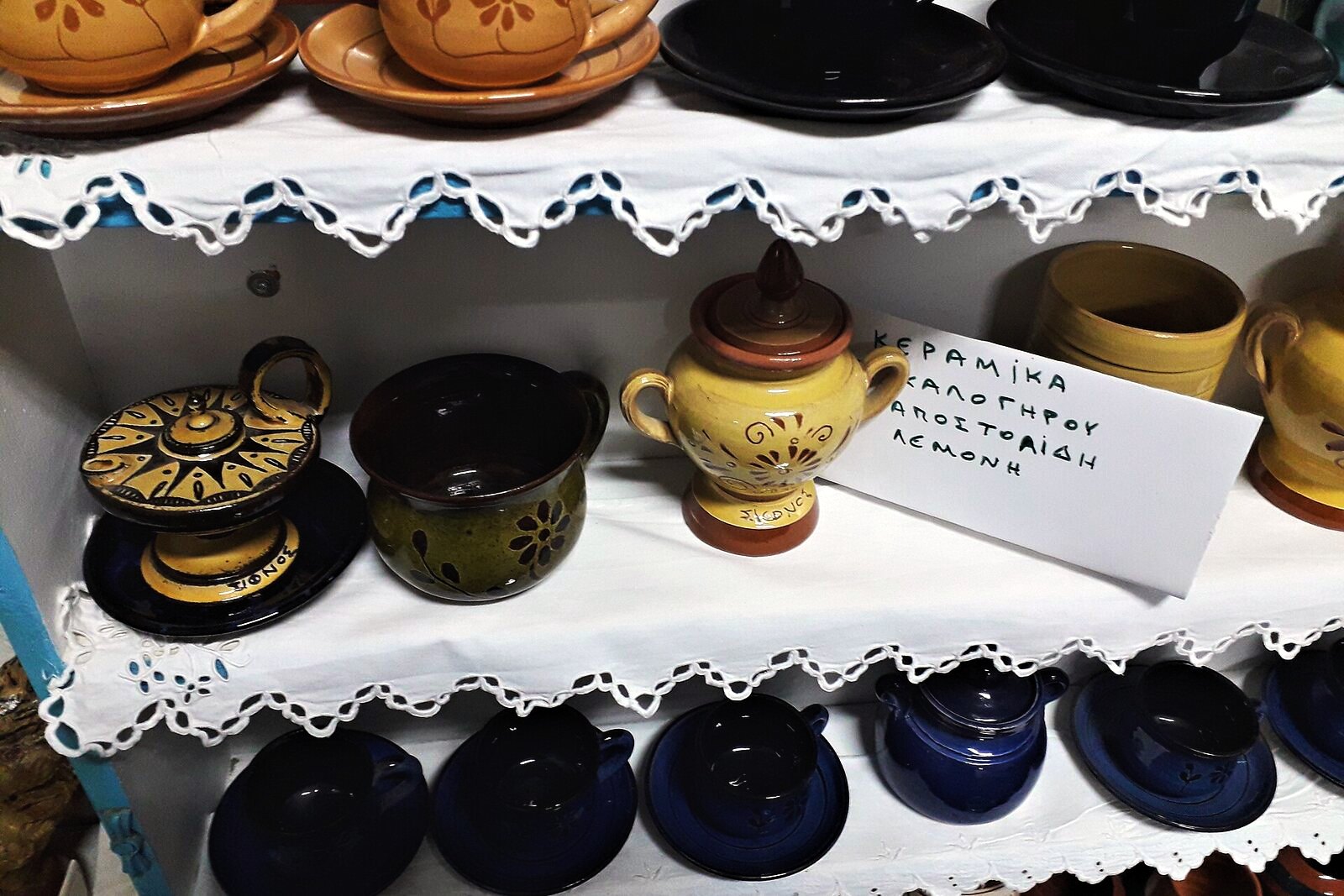
En Sifno (Giannis Apostolidis): the Kamares road, Sifnos
Sifnian clay, dug and prepared by the man at the wheel.
Giannis Apostolidis is the third generation of his family to pot on Sifnos – his grandfather started in the late 1800s, and his son Simos is the fourth – and he still prepares his own clay from Sifnian earth. The workshop is at Leivadas, on the second kilometre of the road from Kamares up to Apollonia, and he is there most days, so you can watch a pot come off the wheel before you choose one. He makes the island’s traditional cookware alongside tableware and decorative pieces, and there is a second display at Platis Gialos if you are staying on the south coast.
Good to knowAn easy stop on the way up from the ferry, or on the way back down to it.
WhereLeivadas, on the Kamares–Apollonia road, and Platis Gialos, Sifnos
Sifnos Stoneware: Artemonas, Sifnos
The island’s tradition, fired harder and glazed anew.
Antonis Kalogirou set up Sifnos Stoneware in Artemonas in 2006 to take the island’s pottery somewhere new. Stoneware is fired hotter than the old earthenware cooking pots, which makes it tougher at the table, and the studio’s glazes include crystalline ones, where crystals grow in the glaze as the kiln cools so that no two pieces come out alike. The range is tableware, vases and smaller pieces with a clean, contemporary line: a dinner plate costs around €18–22 and a large pebble vase around €180. If it won’t fit in the suitcase, the studio sells online.
Good to knowIn summer the studio is open Monday to Saturday, 9am – 8pm; out of season, call ahead on +30 22840 33090.
WhereArtemonas, Sifnos
Lembesis Pottery: Artemonas, Sifnos
A family workshop on its fifth generation.
In Agia Anna, on the edge of Artemonas, the Lembesis family has been making pottery for four generations and is now into its fifth. This is the Sifnian tradition handed down in one family, made and sold in the same place, and it is the kind of workshop the island’s reputation was built on. Artemonas is the village for a slow afternoon, among its windmills and lanes, so make an outing of it and finish with almond sweets at Theodorou, which has been making them by hand since 1933.
Good to knowCall before making a special trip (+30 22840 32010); the family posts new work on Instagram.
WhereAgia Anna, Artemonas, Sifnos
BookSEE THEIR WORK
Kostas Depastas: Cheronissos, Sifnos
The last potter in the potters’ bay.
A century ago Cheronissos, the fishing hamlet in a horseshoe bay at the northern tip of Sifnos, had twenty-five pottery kilns. One potter still works there: Kostas Depastas, at the wheel since 1948, whose workshop on the beach doubles as his shop. It is a twenty-five-minute drive from Artemonas through empty terraces, and the two family tavernas on the bay make it lunch as well as shopping.
Good to knowThere is no website and no posted hours, so call ahead on +30 22840 33121 and go in the middle of the day.
WhereCheronissos, Sifnos
Kerameio: Kato Chora, Serifos
Two sisters, a high-fired kiln and a summer clay school.
Natasa Kalogeropoulou and her sister Jutta opened Kerameio in Kato Chora, just below the Chora of Serifos, in 2014. They make stoneware fired at 1,240°C, tough enough for every day – dinnerware, carafes, vases and candle holders in shapes and glazes of their own – and in summer they run “Play with Clay” sessions for anyone who wants to try the wheel.
Good to knowThe studio closes for the winter; new orders are taken again from early April 2027.
WhereKato Chora, Serifos
Marble: Pyrgos, Tinos
A village of carvers, a school, and a museum to explain them.
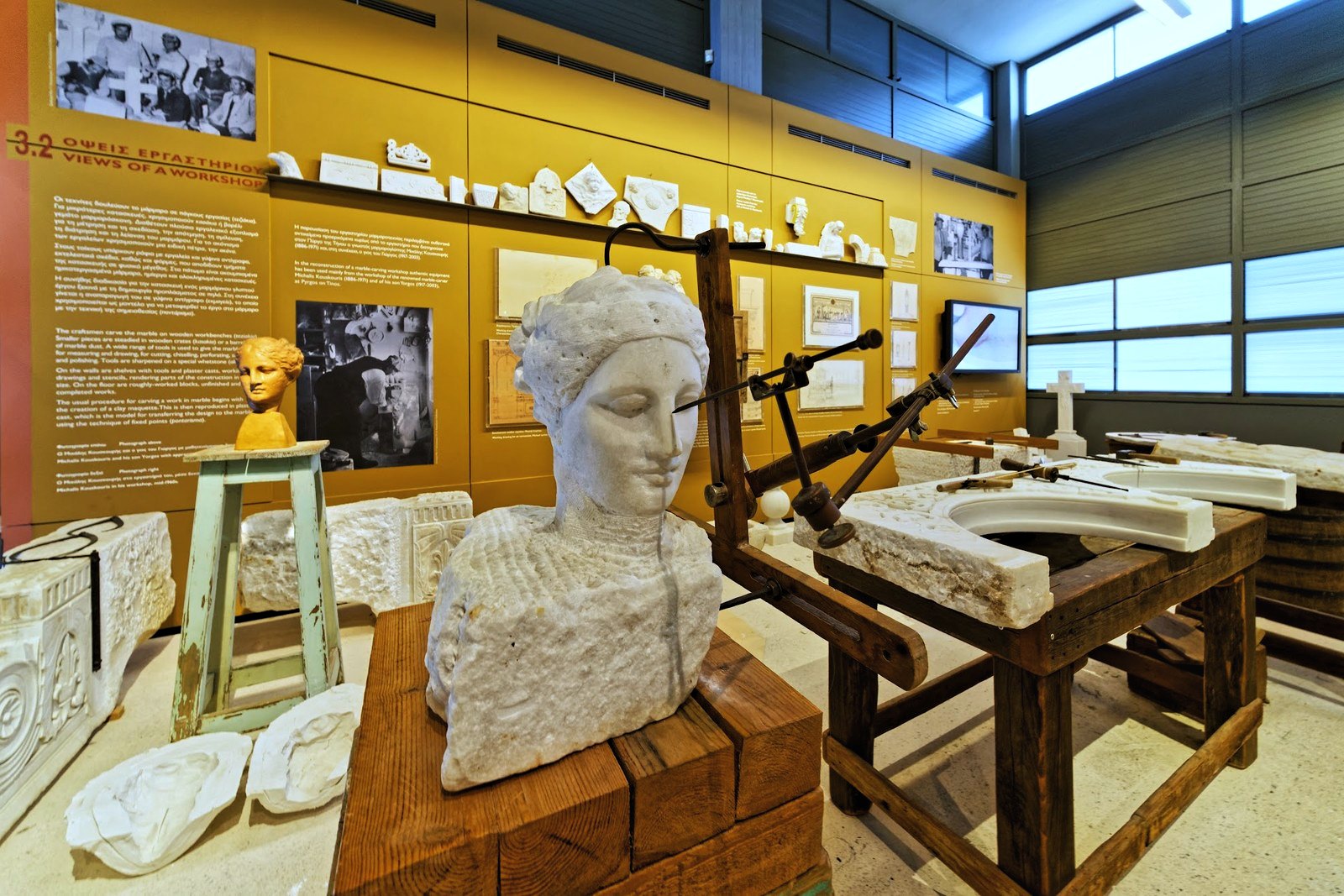
Tinos is made of marble, and Pyrgos, in the north of the island above the bay of Panormos, is where it is carved. The village gave Greece the sculptors Yannoulis Chalepas and Dimitrios Filippotis, its School of Fine Arts has taught carving since 1955, and Tinian marble craftsmanship is on UNESCO’s list of the world’s intangible cultural heritage. Only a handful of professional sculptors still work here. Most carve through the winter and open their studios to sell in summer, so the way to buy is to walk the lanes and step in wherever a door is open and the dust is fresh.
Start at the Museum of Marble Crafts just outside the village, run by the Piraeus Bank Group Cultural Foundation, which follows the stone from quarry to finished work – the tools, the hoists, the clay models and the half-carved pieces – so that you know what you are looking at when you reach the studios. Then sit on the marble square under the plane tree. There is more on the museum and what to buy in our ceramics and craft guide.
Good to knowThe museum is closed on Tuesdays. Come to the village in the afternoon, when the studios that are open in summer have their doors wide.
WherePyrgos, Tinos
Weaving: Naxos and Mykonos
Wool, silk and the old island patterns, still on the loom.
Island households once wove their own blankets, rugs and bags, and the patterns passed from mother to daughter. Two places keep the craft going for visitors: a village cooperative in the mountains of Naxos, and one weaver on Mykonos.
Apiranthos Women’s Cooperative: Apeiranthos, Naxos
The mountain village’s weavers, in a shop facing the church.
Apeiranthos is the marble-paved village high in the mountains of Naxos, and since 1987 its women have run a weaving cooperative, founded at the urging of Manolis Glezos, the village’s most famous son. The shop faces the Panagia church and sells what the members weave on the krevatari, the traditional wooden loom: rugs, bags and cloth in the village’s own patterns, with names like monadrio, pente-pente and stavroto. Each summer they put on an exhibition of their work.
Good to knowThe shop opens from May to October; outside those months, call ahead on +30 22850 61436.
WhereOpposite the Panagia church, Apeiranthos, Naxos
Faye Chatzi: Mykonos
Silk from her own silkworms, wool from Rhenia.
Mykonos was known for its weavers long before it was known for its beach clubs, and Faye Chatzi keeps the craft alive. She raises silkworms for her silk, uses wool from sheep on Rhenia and from the island’s free-roaming flocks, and colours it with plant dyes, then weaves shawls, scarves, hats, home textiles and the tagari, the island’s shoulder bag. These are pieces to keep for life and priced to match: expect several hundred euros, around €570 for a tagari and €620 for a shawl. Her atelier is a working loom inside Kalesma Mykonos, at Aleomandra near Agios Ioannis, and she has also worked on the weaving revival at the Mykonos Folklore Collection.
Good to knowPrivate and small-group weaving lessons on request; enquire through her website.
WhereKalesma Mykonos, Aleomandra, Mykonos
Baskets: Volax, Tinos
Woven by hand among the granite boulders.
Volax is the village built among the round granite boulders in the middle of Tinos, and it is also the island’s basket village. Its weavers have made baskets by hand for generations, and the craft has been on Greece’s national inventory of intangible cultural heritage since 2019. Only a few weavers are left, so there is no shop to name: drive up, walk among the boulders and buy from whoever is weaving in a doorway.
Good to knowVolax is eleven kilometres inland from Chora; pair it with the dovecotes of Tarampados on the way back.
WhereVolax, Tinos
You might also like
- The 10 Best Ceramics and Craft Shops in the Cyclades
- The 10 Best Things to Bring Home from the Cyclades
- The 10 Best Walks, Villages and Potteries in Sifnos
Prices and opening times are approximate and change with the season. If something has changed, let us know.