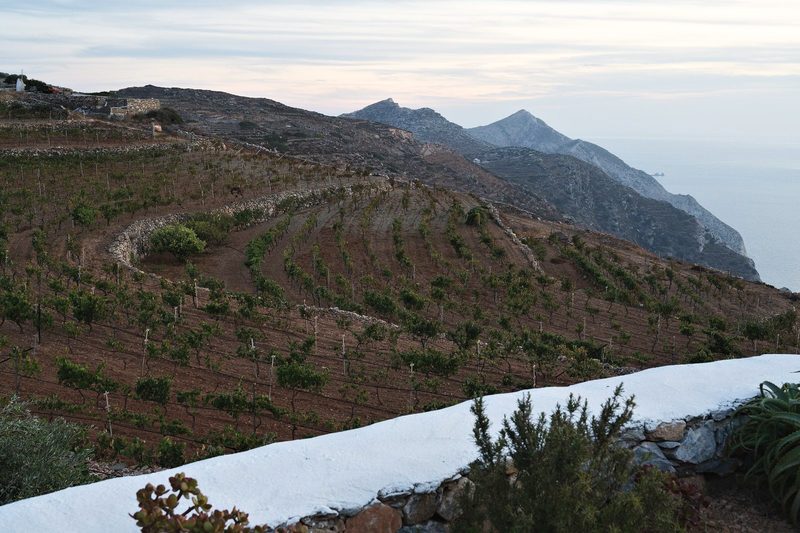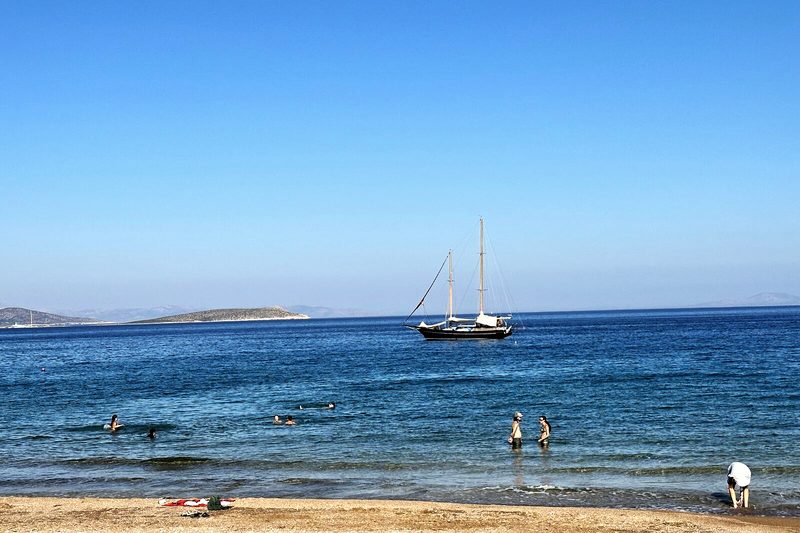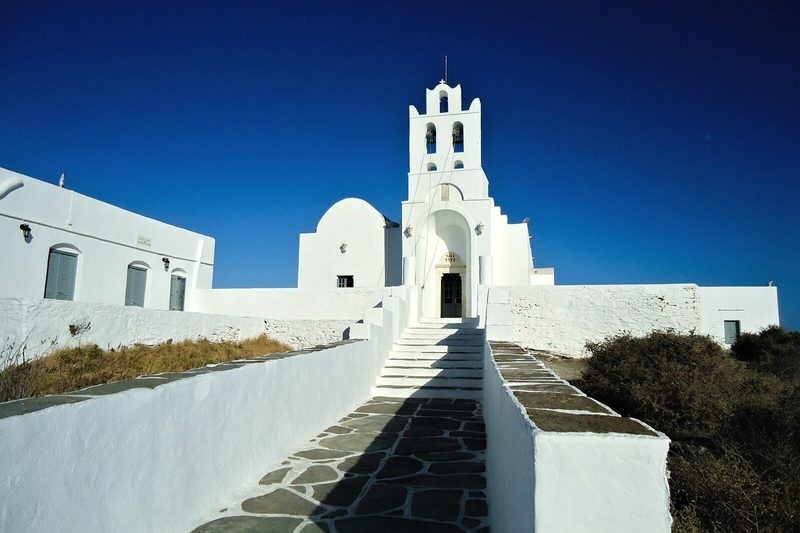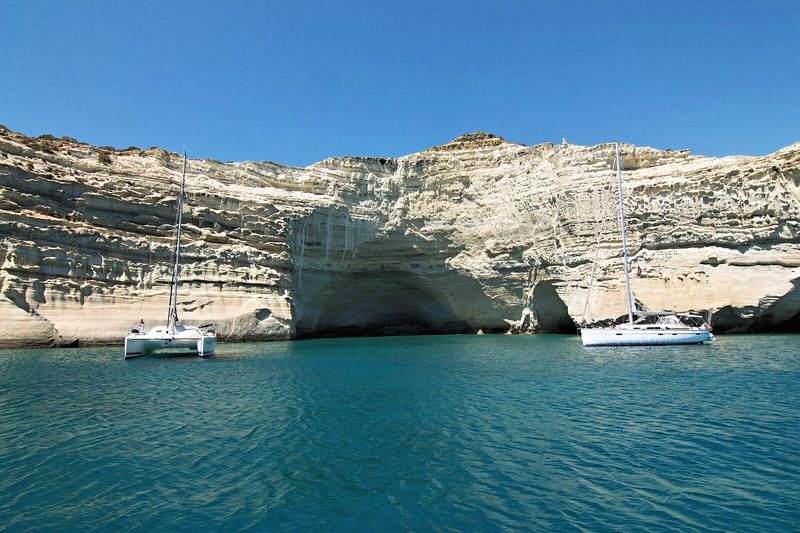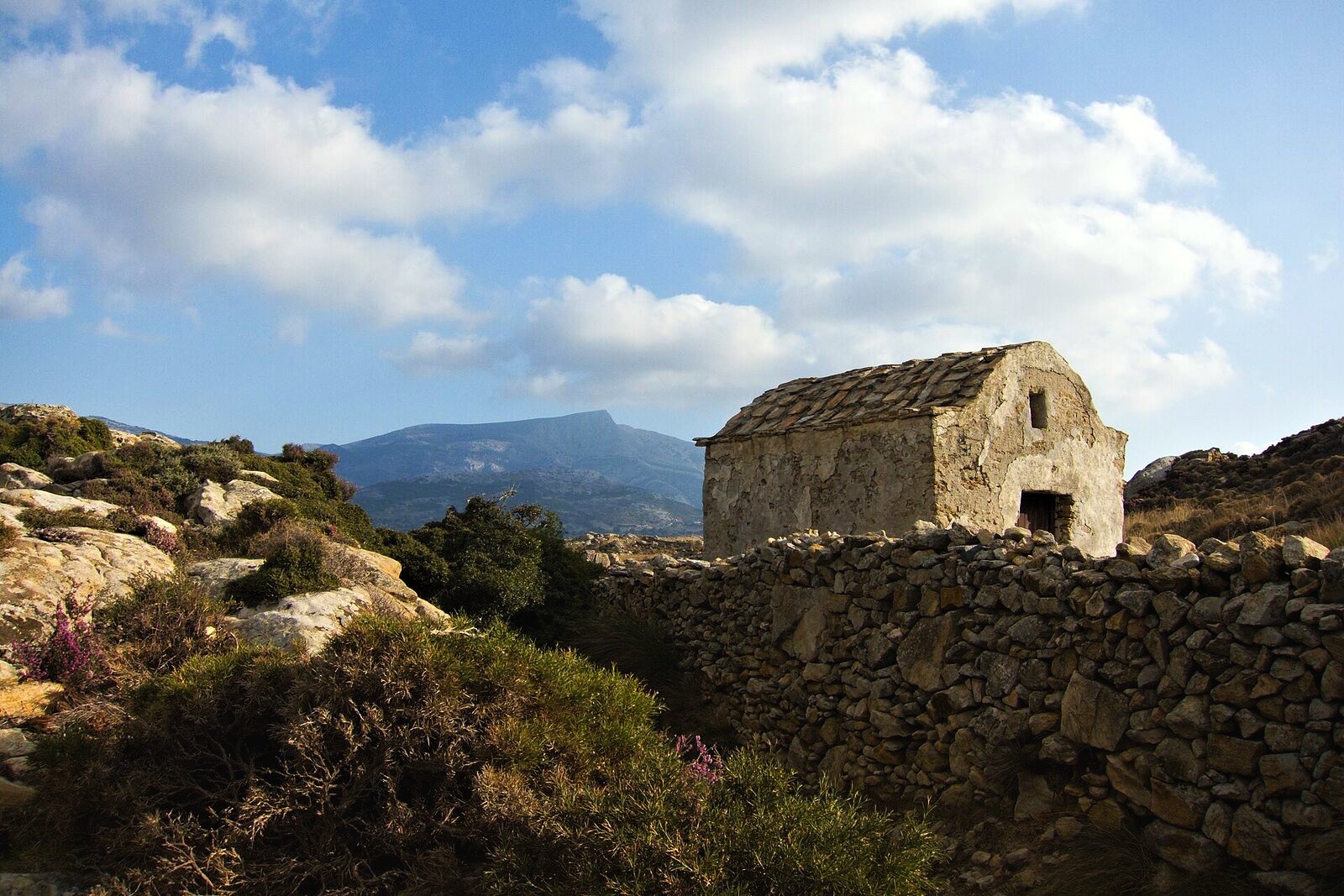
Naxos is the island where you’ll actually need the hire car. The beaches alone could fill a week, but the point of the place is the interior: a mountain with a god’s name, villages paved in marble, temples in fields and colossal statues abandoned where their sculptors downed tools 2,500 years ago. Most of what follows is free, most of it is a short drive from Chora, and the best days pair one of each – a morning on the sand, an afternoon in the hills, a taverna in between. Opening hours and any prices are approximate and change with the season.
The Portara: Naxos’s Marble Doorway
Six metres of marble framing the sunset.
The great door on the islet of Palatia is the first thing you see from the ferry and the last thing you’ll photograph before you leave. It’s all that stands of a temple to Apollo begun around 530 BC by the tyrant Lygdamis and abandoned when he fell a few years later; the rest of the marble went into the Venetian castle across the harbour. Legend puts Theseus’s abandonment of Ariadne on this rock, and Dionysus’s arrival to console her. Walk out along the causeway in the hour before sunset, when the whole town does the same, and watch the sun drop behind Paros through the frame. Go back at seven in the morning and you’ll have it to yourself.
Good to knowAlways open, free, and busiest at sunset. The causeway is uneven; wear something better than flip-flops.
CostFree
WherePalatia islet, Chora, Naxos
Mount Zas: The Roof of the Cyclades
Thyme, goat bells and the whole Aegean from just over 1,000 metres.
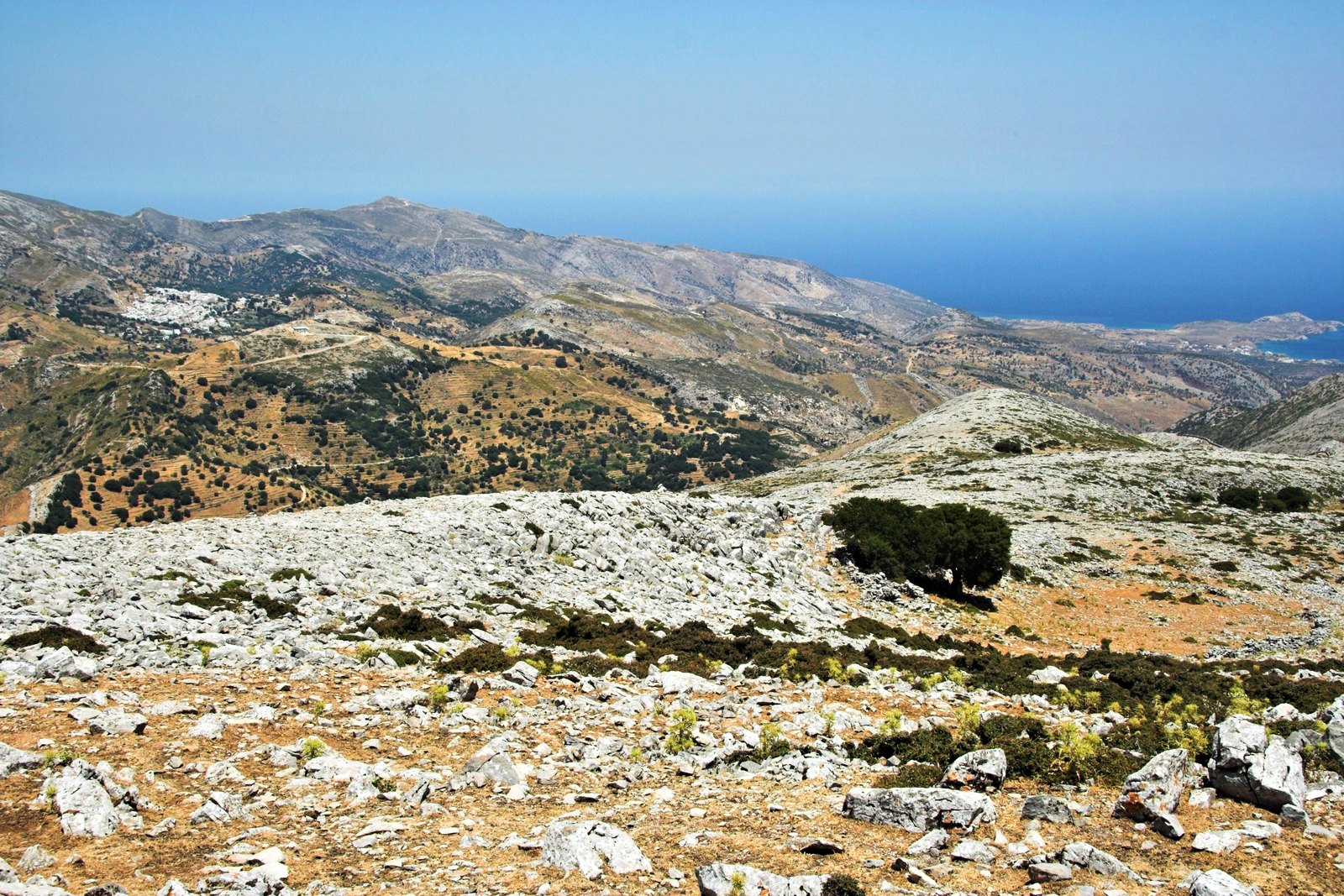
Zas – Zeus – is the highest mountain in the Cyclades, and the walk to its summit is the best half-day on the island. Start at the chapel of Agia Marina on the road above Filoti, where a signed path climbs through walled fields and thyme to a ridge and then the bare marble top; allow about two hours up and an hour and a half down, with a steep final section. From the summit you’ll count islands: Paros, Mykonos, Amorgos, Ios, Santorini on a clear morning. The longer route from the Aria spring passes the Cave of Zas, where the god was supposedly raised. Go early, take two litres of water and a hat, and have lunch waiting at Amorginos in Apeiranthos or on the square in Filoti.
Good to knowNo shade on the upper mountain; avoid midday in July and August. The path is waymarked but rough.
CostFree
WhereAgia Marina, above Filoti, Naxos
Chalki: The Village That Taught Naxos to Linger
Neoclassical façades, citron liqueur and the island’s best gallery.
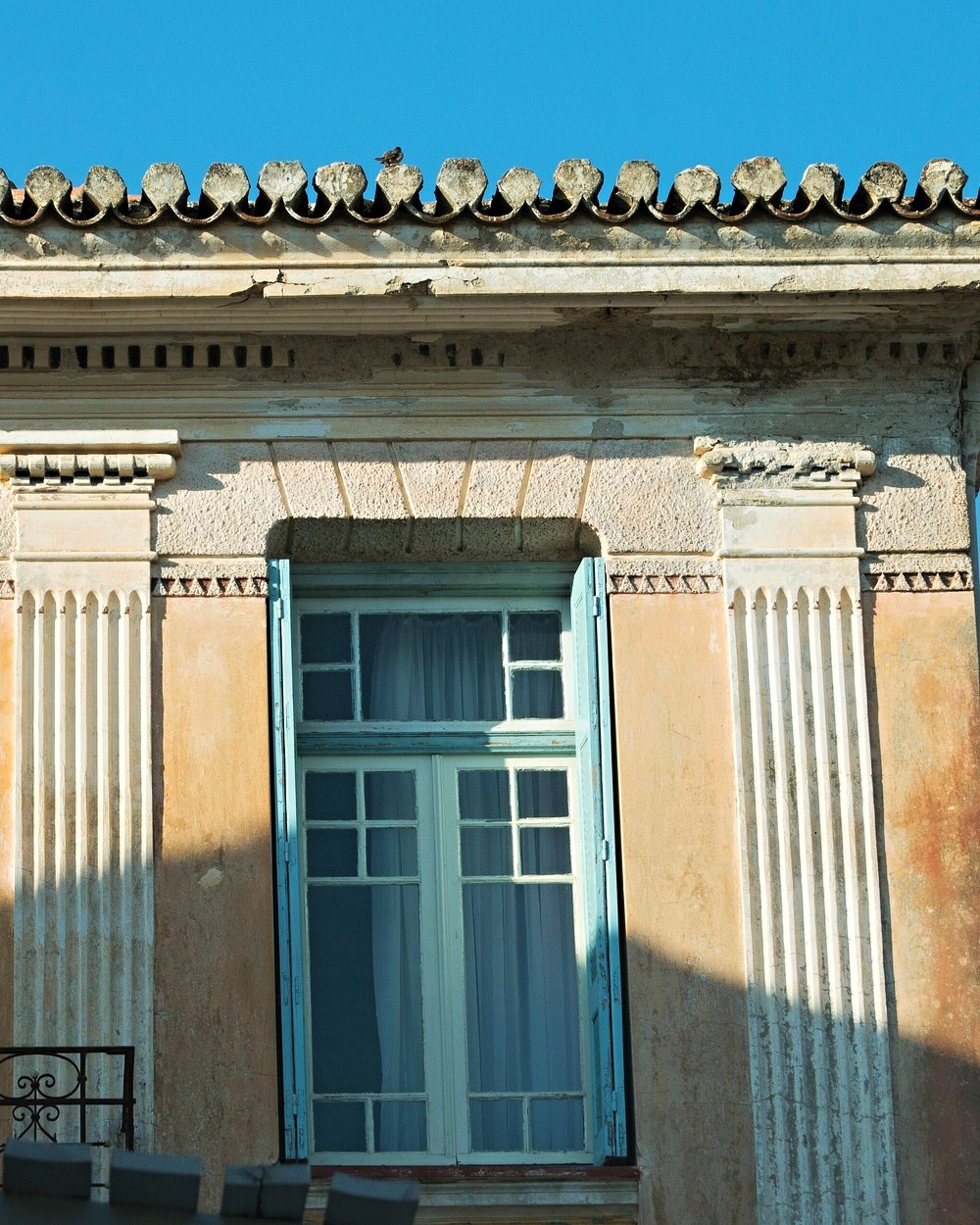
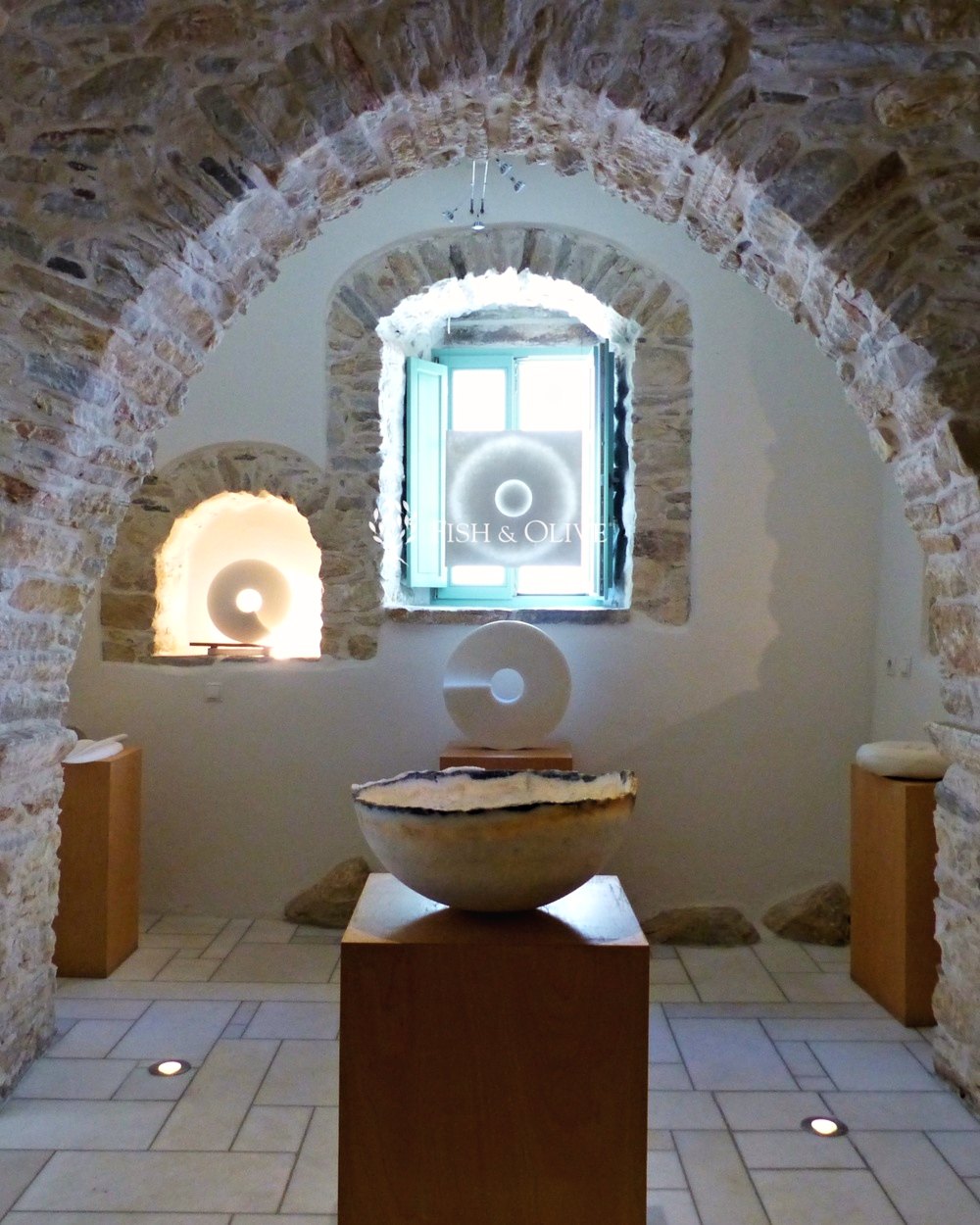
Chalki was once the island’s capital and still feels like its living room: a village of ochre neoclassical houses and Venetian towers on the Tragaia plateau, with a plane-shaded square and olive groves in every direction. The programme is simple. Taste the three colours of kitron at the Vallindras distillery, open since 1896: a short look at the old stills and a cheap (sometimes free) tasting, ten minutes rather than a tour. Cross the lane to Fish & Olive, the shop and gallery where Katharina Bolesch’s olive-and-lizard ceramics and Alexander Reichardt’s fish jewellery have drawn collectors since 2000. Then lunch under the trees on the square, and drive or walk the two and a half kilometres out to the Byzantine chapel of Panagia Drosiani, just short of Moni, one of the oldest churches in the Aegean.
Good to knowFish & Olive opens daily from May to October, about 10am to 4.30pm. Vallindras opens mornings and summer evenings.
CostFree to wander; kitron bottles from about €4
WhereChalki, Naxos
Apeiranthos: Marble Lanes and Cretan Blood
A mountain village paved in marble, with four museums and a balcony for lunch.
Apeiranthos sits 650 metres up on the flank of Fanari, about 40 minutes from Chora, and its lanes are paved and stepped in white marble worn smooth by six centuries of feet. The village was settled by Cretans and still sounds and cooks like it; the dialect, the music and the cooking all have a Cretan accent. Spend a morning on the lanes between the Zevgoli and Bardani towers, look into the small museums – archaeological, geological, folklore and natural history – drink a coffee on the terrace overlooking the valley, eat the pork rosto on the balcony at Amorginos, and buy the hand-woven textiles the village women still make. On the drive back, stop at Rotonda above Filoti for the view.
Good to knowPark at the entrance to the village; the lanes are pedestrian. The archaeological collection charges €5 and closes on Tuesdays; the other museums keep their own hours.
WhereApeiranthos, Naxos
The Kouros of Apollonas: A Giant Asleep in His Quarry
Ten metres of marble that never stood up.
Drive to the far north of the island, through the emery country and down to the fishing village of Apollonas, and walk up the signed path above the bay. Lying on his back in the ancient quarry is a kouros more than ten metres long, roughed out in the early sixth century BC and never finished: the bearded, cloaked figure is probably Dionysus rather than Apollo. Nobody knows for certain why the sculptors stopped – the best guess is that he was simply too heavy to move, and the cracks across him agree – and the colossus has lain here for 2,600 years, with the sea below and the thyme growing round him. Swim at Apollonas afterwards and eat fish on the harbour; it’s about an hour from Chora, so make a day of it.
Good to knowFree and unfenced; please don’t climb on him. Bus lines 2 and 5 reach Apollonas a handful of times a day, line 5 on weekdays only.
CostFree
WhereApollonas, Naxos
Agios Prokopios and Plaka: The Long Western Sand
Knee-deep turquoise in the morning, kilometres of dunes in the afternoon.
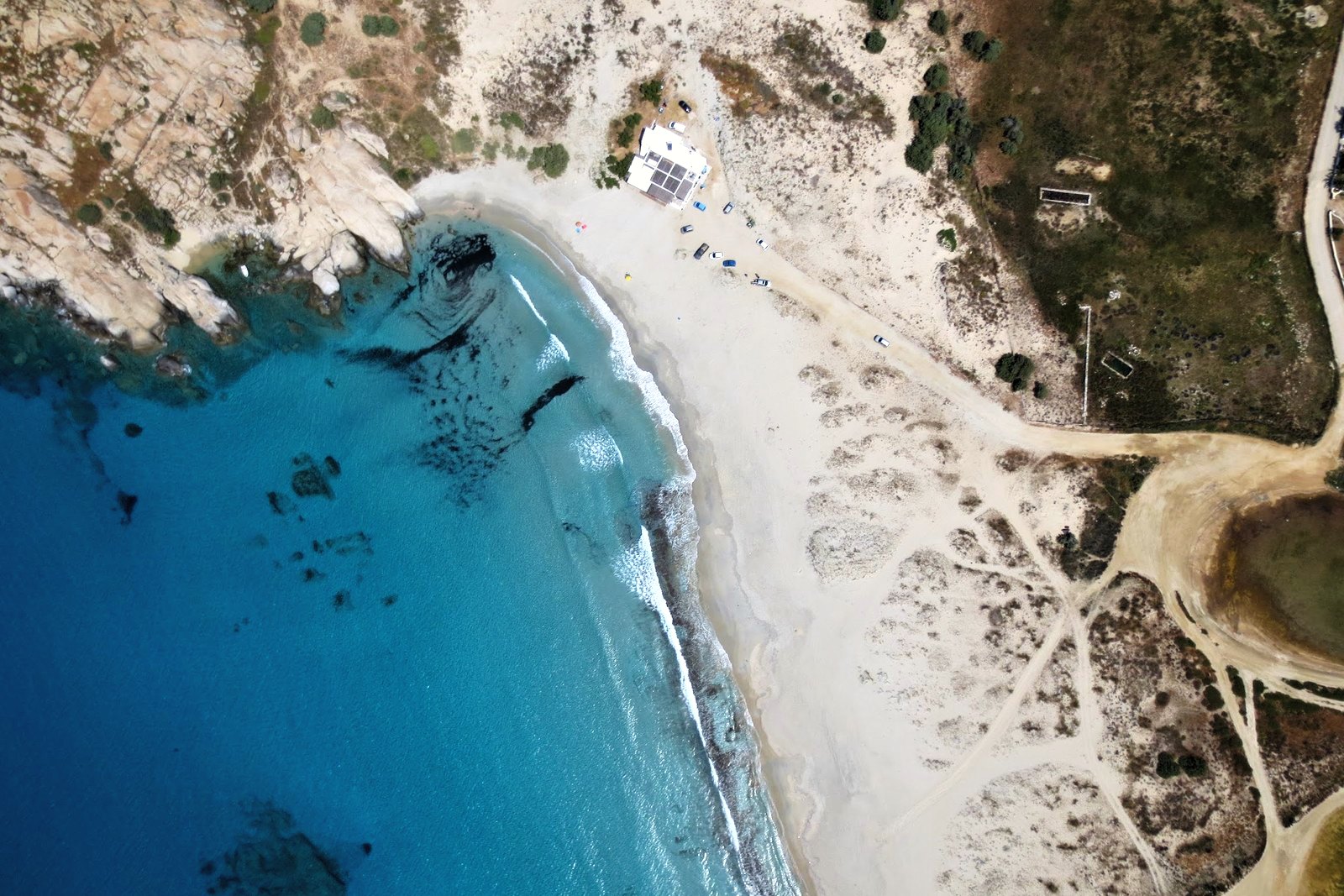
Naxos’s west coast is one beach pretending to be several. Agios Prokopios, six kilometres from Chora and sheltered by the Stelida headland, is the organised one: fine sand, water so clear you can count your toes, sunbeds, tavernas and a bus every half hour in summer. Walk south through Agia Anna and the beach becomes Plaka, four kilometres of pale sand backed by dunes and cedar scrub that run on, with breaks, almost to Mikri Vigla, with sunbeds thinning as you go until there’s nothing but you, the wind and a few people who have forgotten their swimsuits. Swim at Prokopios in the morning, walk Plaka in the afternoon, and finish with a sundowner at one of the beach bars behind the dunes.
Good to knowAgios Prokopios is the most sheltered beach when the meltemi blows; southern Plaka is naturist-friendly.
CostSunbeds and umbrellas from a few euros each
WhereAgios Prokopios and Plaka, Naxos
Mikri Vigla: Learn to Kitesurf Where the Wind Lives
Eighty per cent windy days and a sandy launch.
Mikri Vigla is a headland splitting two beaches twelve kilometres south of Chora, and the meltemi funnels through it with a Venturi effect that gives the north side wind on more than eight days in ten through summer. That makes it one of the best kitesurfing spots in Greece, and Flisvos Kitecentre on Orkos beach has been teaching here for years: IKO-certified courses in five languages, rescue boat on the water, rental gear for those who already ride and a hotel and restaurant behind the launch. Beginners get a sandy, waist-deep bay to learn in; experienced riders get a flat-water playground with a view of Paros. Non-kiters swim on the sheltered south side and watch the show.
Good to knowWind is most reliable from June to September; in May and June the centre takes 15 per cent off its hotel if you book a course with it.
WhereMikri Vigla, Naxos
BookBOOK A LESSON
The Temple of Demeter: White Marble in the Wheat
A sixth-century temple rebuilt from its own stones, and the fields it was built for.
A kilometre and a half south of Sangri, on a low hill among fields, stands the temple the Naxians built to Demeter around 530 BC, entirely in their own white marble and in an early Ionic style that would influence the Parthenon. It was turned into a Christian basilica in the sixth century, lost, and rediscovered in 1949; Greek and German archaeologists partly re-erected it in the 1990s using the original blocks, and the result is one of the most peaceful sites in the Cyclades. A small museum beside the temple holds the fragments that couldn’t be reused, and one ticket covers both. Come first thing, before the heat, or in the last hour before the gate shuts at 3.30pm, and drive on to the Bazeos Tower nearby if there’s a concert.
Good to knowSite and museum open about 8.30am to 3.30pm, closed Tuesdays. Signed road and small car park; about a 20-minute walk from Sangri if you come by bus.
Cost€5 (€3 reduced), covering the site and the museum
WhereGyroulas, near Sangri, Naxos
The Venetian Kastro: A Thirteenth-century Hilltop Still Lived In
Marble lintels, Catholic bells and a lift to the view.
The citadel Marco Sanudo built in 1207, when he made Naxos the seat of his Duchy of the Archipelago, is not a ruin but a neighbourhood. Walk in through the Trani Porta, the great north-west gate, and you’re among the mansions of the old Venetian families, their coats of arms over the doors, the Catholic cathedral at the centre and the Glezos tower, the last of the twelve, at the edge. The Archaeological Museum is closed for a major expansion; its Cycladic figurines and Mycenaean finds are showing meanwhile in the Ursuline convent’s cultural centre. Take the free lift to the top for the Avaton 1739 café and the best view of town, and come back for an evening concert in one of the courtyards.
Good to knowThe Kastro is free to wander at any hour; museums inside keep their own hours. Lanes are steep and stepped.
CostFree
WhereKastro, Chora, Naxos
Kalamitsia: The Jesuits’ Lost Summer Palace
A seventeenth-century mansion, abandoned among olives.
Two kilometres up a dirt track from Melanes stands one of the strangest buildings on Naxos: a two-storey Jesuit country house built in 1673 on the ruins of a Venetian mansion, with kitchens, stables, laundries, cells and a chapel, abandoned a long time ago and slowly going back to the hillside. The walls still stand, arches frame olive groves and low hills, and you’ll almost certainly have it to yourself. Walk in from Melanes or from the kouroi at Flerio – about half an hour on foot – or bump along the track by car. Tread carefully inside; the floors and roofs are not what they were. Lunch afterwards at O Giorgis, back at the village entrance.
Good to knowFree and unfenced; take care on upper floors. Bus line 4 reaches Melanes.
CostFree
WhereNear Melanes, Naxos
Alyko: Cedars, Dunes and a Hotel That Never Opened
Juniper shade, white coves and graffiti on concrete.
Eighteen kilometres south of Chora, the beach road finally gives up at Alyko, a headland covered in a rare forest of low cedar – strictly juniper – growing out of sand dunes above a string of white coves. It’s the most exotic landscape on the island: trees sculpted flat by the wind, sand as fine as flour, water in half a dozen blues and no sunbeds at all. On the point stands the concrete shell of a hotel begun decades ago and never finished, now covered in large-scale murals by Greek and international street artists, which makes it the most photographed ruin in the Cyclades after the Portara. Pick a cove, bring your own shade and water, and stay for the sunset.
Good to knowNo facilities; the nearest tavernas are at Pyrgaki and Kastraki. Protected habitat – keep to the paths through the dunes.
CostFree
WhereAlyko, Naxos
The Kouroi of Melanes: Two Giants in a Garden
Unfinished statues lying where they were carved, among the fig trees.
Before you go north for the Apollonas colossus, see his brothers. In the valley at Flerio above Melanes, two kouroi of the same period lie in the gardens where their sculptors abandoned them, one in a walled orchard by a stream, the other on the hillside above. Each is about five metres long, each broken at the feet as it was being moved, and together with the Apollonas giant they explain why Naxos was the marble workshop of archaic Greece. A short path links them through terraces of fig and olive, past the spring sanctuary where the quarrymen prayed to the giant twins Otus and Ephialtes. Pair the visit with Kalamitsia and lunch at O Giorgis for the best inland half-day on the island.
Good to knowFree entry; the lower kouros sits in a private garden where the family may offer you a coffee. Bus line 4 to Melanes.
CostFree
WhereFlerio, Melanes, Naxos
You might also like
- Naxos: The Big-hearted Island
- The 11 Best Restaurants in Naxos
- The Meltemi: The Wind That Runs the Cyclades
Prices and opening times are approximate and change with the season. If something has changed, let us know.